Prosopis africana
|
|
Prosopis africana Common Names: African
mesquite, Iron tree, Sassy wood Scientific
Classification Kingdom: Plantae Phylum: Tracheophyta Class: Magnoliopsida Order: Fabales Family: Fabaceae Genus: Prosopis Species: P. africana Synonyms: Coulteria africana Guill. & Perr.; Prosopis oblonga Benth.; Anonychium lanceolatum Schweinf.; Anonychium africanum (Guill. & Perr.) C.E.Hughes & G.P.Lewis Morphological Description Prosopis africana is a slow-growing, deciduous tree commonly reaching 4–20 m
tall, with an open crown and drooping foliage (Orwa et al., 2009; Useful
Tropical Plants, n.d.). It is widely recognized as an ecologically important
dryland tree, often retained in parklands and fallows. · Trunk and Bark: Bark very dark and scaly; the slash is
orange to red-brown with pale streaking (Orwa et al., 2009). The species is
frequently described locally as “ironwood” due to its hard, durable timber
(Orwa et al., 2009). · Buttresses: Slightly rounded buttresses may occur on older stems (Orwa
et al., 2009). · Leaves: Alternate, bipinnate; rachis typically 10–15 cm, with 3–6
pairs of opposite pinnae (5–8 cm); each pinna bearing 9–16 pairs of
oblong-lanceolate leaflets (approximately 12–30 mm), often pubescent; a gland
is commonly present between pairs of pinnae and between leaflets (Orwa et al.,
2009). · Flowers: Greenish-white to yellow, fragrant, borne in dense axillary
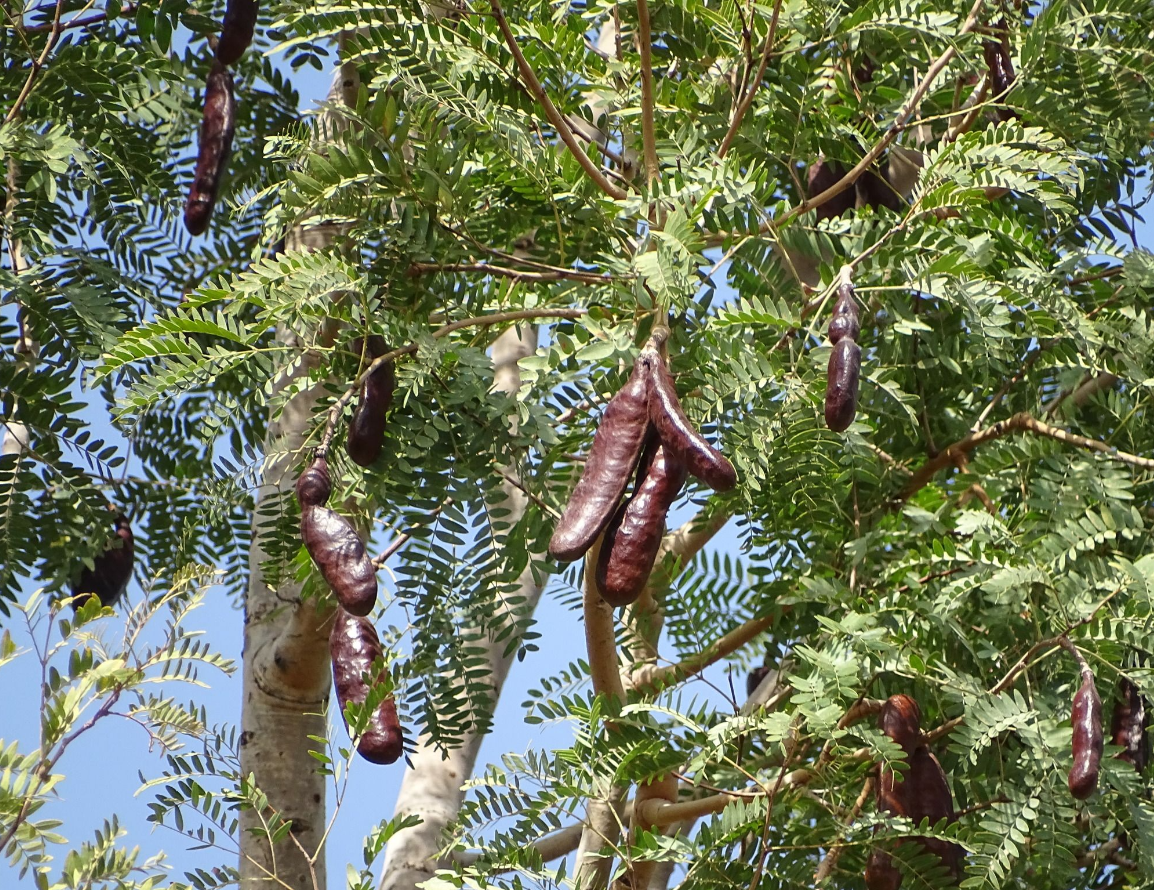
spikes commonly 6–10 cm long (Orwa et al., 2009). · Fruit and Seeds: Pods dark brown, thick and hard, shiny;
reported up to about 15 × 3 cm, with woody walls and compartmenting; seeds are
loose and may rattle inside the pod (Orwa et al., 2009). Distribution and Habitat Prosopis africana is the only tropical African species in the genus Prosopis and occurs broadly from Senegal eastward
toward Ethiopia, particularly in the transitional belt between Sahel and
savanna forests (Orwa et al., 2009). Species-level taxonomy and occurrence are
supported by global biodiversity databases (GBIF Secretariat, n.d.). · Ecological Zone: Sahelian to Sudanian savanna mosaics;
commonly found in fallow lands and agroforestry parklands (Orwa et al., 2009). · Altitude: Reported up to about 1,000 m (Orwa et al., 2009). · Climate Tolerance: Documented across high-heat environments;
the agroforestry profile reports a mean annual temperature range reaching up to
40°C and notes suitability in dry environments (Orwa et al., 2009). · Soils: Frequently reported on sandy to clayey soils over laterite
and described as tolerating many soil types (Orwa et al., 2009). Conservation and
Pressure: Due to extensive
overexploitation, the agroforestry profile notes local disappearance from parts
of the southern Sahel and adjacent Sudan savannas (Orwa et al., 2009). This is
consistent with the species’ high demand for fuelwood and durable timber in
dryland regions. Ethnopharmacology Traditional uses across
West Africa include management of pain, inflammation, malaria-like febrile
illnesses, and topical wound care. · Analgesic and Anti-inflammatory (traditional
pain uses): In a rat/mouse
model study, methanol stem bark extract (62.5–250 mg/kg) reduced acetic
acid-induced writhing, with 76.89% inhibition at 250 mg/kg (compared with
83.16% for piroxicam). In carrageenan-induced paw edema, anti-inflammatory
activity became significant from the third hour onward. Preliminary screening
indicated presence of flavonoids, tannins, saponins, alkaloids, and cardiac
glycosides (Ayanwuyi et al., 2010). · Wound Care and Hemostatic Use (traditional wound
management): Methanol stem bark
extract significantly reduced bleeding/clotting and coagulation time in rats,
reduced epithelialization period in excision wounds, and inhibited multiple
bacterial strains relevant to wound infection including Staphylococcus aureus, Pseudomonas aeruginosa, Klebsiella pneumoniae, Salmonella typhi, and Bacillus subtilis. The study also reported phytochemical
positivity for alkaloids, saponins, tannins, flavonoids, steroids, terpenoids,
and carbohydrates (Ezike et al., 2010). · Antimalarial (traditional febrile and malaria
treatment): A
fractionation-guided in vivo study (mouse Plasmodium berghei model) reported that methanol, n-hexane,
and ethyl acetate stem bark extracts suppressed parasitemia by 90.0%, 72.2%,
and 73.6%, respectively. A chromatographic fraction (F5) showed 91.09%
suppression at 12.5 mg/kg body weight, reported as exceeding chloroquine
(87.79%) under the study conditions, and was associated with restoration of
hematological indices and CD4+ counts. UPLC-QMS annotation of F5 reported
compounds including caffeate, catechin, quercetin, apigenin-related annotation,
terpinene-4-ol, linalool, quinovic acid, and prosopinine among identified
constituents (Abubakar et al., 2024). · Dental Care and Anti-biofilm (traditional oral
hygiene applications): Aqueous
leaf and stem bark extracts were investigated against dental-caries-relevant
targets. The aqueous stem bark extract showed strong antioxidant performance
(ABTS IC50 = 4.58 ± 0.07 µg/mL), lipoxygenase inhibition (IC50 = 13.42 ± 1.26
µg/mL), anti-biofilm activity (63.6% at 100 µg/mL without reducing bacterial
growth), and anti-quorum sensing inhibition (53.5%). The work evaluated
antibiofilm effects on Streptococcus mutans ATCC 25175 among other strains, aligning with dental caries
management claims (Bance et al., 2021). ⚠ Toxicity Profile: Acute toxicity varies by extract, dose, and route. In a
pain/inflammation study, oral median lethal dose estimates were reported as
3807.9 mg/kg in mice and greater than 5000 mg/kg in rats for the methanol stem
bark extract under the study conditions (Ayanwuyi et al., 2010). In a
wound-care study, an intraperitoneal LD50 of 774 mg/kg in mice was reported for
a methanol stem bark extract, highlighting that route of exposure can
substantially change toxicity outcomes (Ezike et al., 2010). Additional Uses · Food and Fermentation: Seeds are used to produce fermented
condiments known as okpeye/okpehe/okpiye. A classical fermentation study
documented natural fermentation over 96 hours with microbial growth reaching
approximately 106–108 cfu/g and frequent dominance
of Bacillus spp.,
particularly B. subtilis and B. licheniformis (Achi, 1992). Modern microbiological
evaluations continue to report food-safety and quality concerns linked to
spontaneous fermentation processes (Agunwah et al., 2024). · Microbial Diversity in Okpeye: Culture-based work on Nigerian
okpehe/okpeye documented diversity of Bacillus species associated with the product and
emphasized its role as a low-cost protein source (Oguntoyinbo et al., 2010). · Agroforestry and Dryland Rehabilitation: Frequently retained in fallow and parkland
systems; the agroforestry profile emphasizes its role in dryland landscapes and
notes significant pressure from overexploitation (Orwa et al., 2009). · Timber and Fuel: The wood is widely sought for durable
implements and fuel due to its hardness and perceived “ironwood” quality; the
agroforestry profile highlights high utilization pressure across its range
(Orwa et al., 2009). References
External Links More Pictures |
|
| Compounds of Prosopis africana |
|
| References |