Spathodea campanulata
|
|
Spathodea campanulata Common Names: African tulip, scarlet bells Scientific
Classification Kingdom: Plantae Clade: Tracheophytes Clade: Angiosperms Order: Lamiales Family: Bignoniaceae Genus: Spathodea Species: S. campanulata Binomial Name: Spathodea campanulata P. Beauv. Synonyms: Spathodea nilotica Seem. Morphological Description Spathodea campanulata, commonly known as the African tulip tree, is a medium-sized,
deciduous tree that typically grows to heights of 10–35 meters, with
exceptional specimens reaching up to 40 meters under ideal conditions (Gilman
et al., 2018). The trunk, often buttressed at the base, supports a round, heavy
crown of dense, dark green foliage, with pinnate leaves that are glossy above
and paler beneath, measuring 30–50 cm long and comprising 5–19 leaflets, each
7–15 cm in length (Tropical Plants Database, 2024). The tree is renowned for
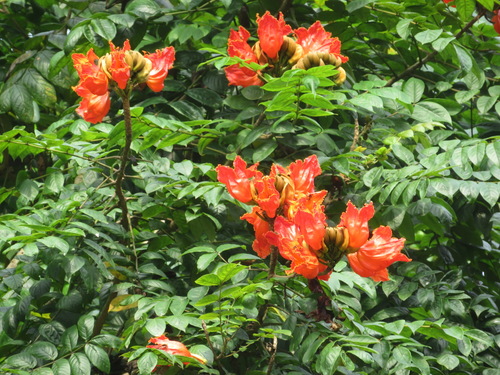
its striking, bell-shaped flowers, 8–12 cm long, ranging from yellow to vibrant
orange-red with yellow-tipped margins, borne in terminal racemes of 10–20
blooms primarily from late winter to spring, though flowering can occur
sporadically year-round in tropical climates (Ng, 2006). The fruit is a woody,
boat-shaped capsule, 15–25 cm long, transitioning from green to brown as it
matures, splitting open to release numerous winged seeds, each about 2 cm long,
aiding wind dispersal (Gilman et al., 2018). Distribution and Habitat Native to Western Tropical
Africa, from Senegal to Angola, Spathodea campanulata has been widely introduced and naturalized
across tropical and subtropical regions globally, including Southeast Asia,
Central and South America, the Caribbean, and Pacific Islands like Hawaii (CABI,
2024; Ng, 2006). It thrives in wet tropical biomes, favoring elevations from
sea level to 2,000 meters, with optimal growth in areas receiving 1,200–2,500
mm of annual rainfall and temperatures of 20–30°C (Gilman et al., 2018). The
tree prefers well-drained, fertile soils—loamy or sandy—with a pH of 5.5–7.0,
though it exhibits moderate drought tolerance once established, making it
adaptable to disturbed sites like roadsides and abandoned fields (Tropical
Plants Database, 2024). Ethnopharmacology Spathodea campanulata, commonly known as the African tulip tree, possesses a variety of
medicinal properties that have been documented in traditional medicine across
tropical Africa and parts of Asia. Different parts of the plant, including the
bark, leaves, and flowers, are used for therapeutic purposes. The bark is
traditionally employed for treating wounds, fever, and skin infections due to
its antimicrobial and anti-inflammatory properties. Extracts from the leaves
and flowers have shown antidiabetic, antioxidant, analgesic, and antimalarial
activities in various studies. For instance, methanolic extracts of the bark
and leaves have demonstrated significant antioxidant activity attributed to the
presence of flavonoids and phenolic compounds. Additionally, the plant exhibits
anti-ulcer and hepatoprotective properties in animal studies, and is sometimes
used as a remedy for diarrhea, dysentery, and toothaches in traditional
medicine. While its broad pharmacological potential is promising, further
research and clinical studies are needed to fully validate its efficacy and
safety. Antimalarial Activity: In Uganda, leaf decoctions treat malaria;
stem bark extracts (200–400 mg/kg) suppressed Plasmodium berghei parasitemia by 60–75% in mice, attributed
to ursolic acid and spathodic acid (Amusan et al., 1996). · Anti-inflammatory and Analgesic: In Ghana, bark poultices alleviate
inflammation and pain. Ethanol bark extracts reduced carrageenan-induced paw
edema in rats by 55% at 200 mg/kg, linked to flavonoids and phenolic compounds
(Ofori-Kwakye et al., 2011). · Antidiabetic Effects: In Nigeria, leaf infusions manage
diabetes. Aqueous extracts lowered blood glucose by 30% in alloxan-induced
diabetic rats at 250 mg/kg, due to antioxidant polyphenols (Ng, 2006; N’guessan
et al., 2011). · Antimicrobial Properties: In Cameroon, flower extracts treat skin
infections and wounds. Methanol leaf extracts showed a minimum inhibitory
concentration (MIC) of 125 μg/mL against Staphylococcus aureus, supporting wound-healing claims (Padhy, 2021). These uses are bolstered
by its rich chemical profile, with over 57 compounds identified, including
caffeic acid and ajugol, enhancing its therapeutic potential (Heim et al.,
2022). ⚠ Toxicity Profile: While Spathodea campanulata is widely used medicinally, it exhibits
mild toxicity. The flowers and leaves contain iridoids and glycosides toxic to
certain insects, notably bees, causing disorientation at high doses (Ng, 2006).
Acute toxicity studies in rats showed no mortality at 2,000 mg/kg of bark
extract, though gastrointestinal irritation occurred at higher doses
(Ofori-Kwakye et al., 2011). Human toxicity is minimal when used traditionally,
but excessive consumption may cause nausea or allergic reactions in sensitive
individuals (Tropical Plants Database, 2024). Additional Uses · Ornamental Value: Its vivid flowers make it a popular
ornamental in tropical gardens and urban parks, often lining streets for shade
(Gilman et al., 2018). · Ecological Impact: Considered invasive in Hawaii and Pacific
Islands, it outcompetes native flora, forming dense stands that alter
ecosystems (CABI, 2024). · Material Use: The lightweight wood (density 0.3–0.4 g/cm³) is used for
carvings and fuel, while seeds historically served as fish poison in
traditional practices (Ng, 2006). References
External Links
More Pictures |
|
| Compounds of Spathodea campanulata | |
| References | Murtala Muhammad, Etal. (2023). Phytochemical analysis of Nigerian medicinal plants. NMPP-DB
Project, Department of Biochemistry, Kano University of Science and Technology,
Wudil |