Acalypha ornata.
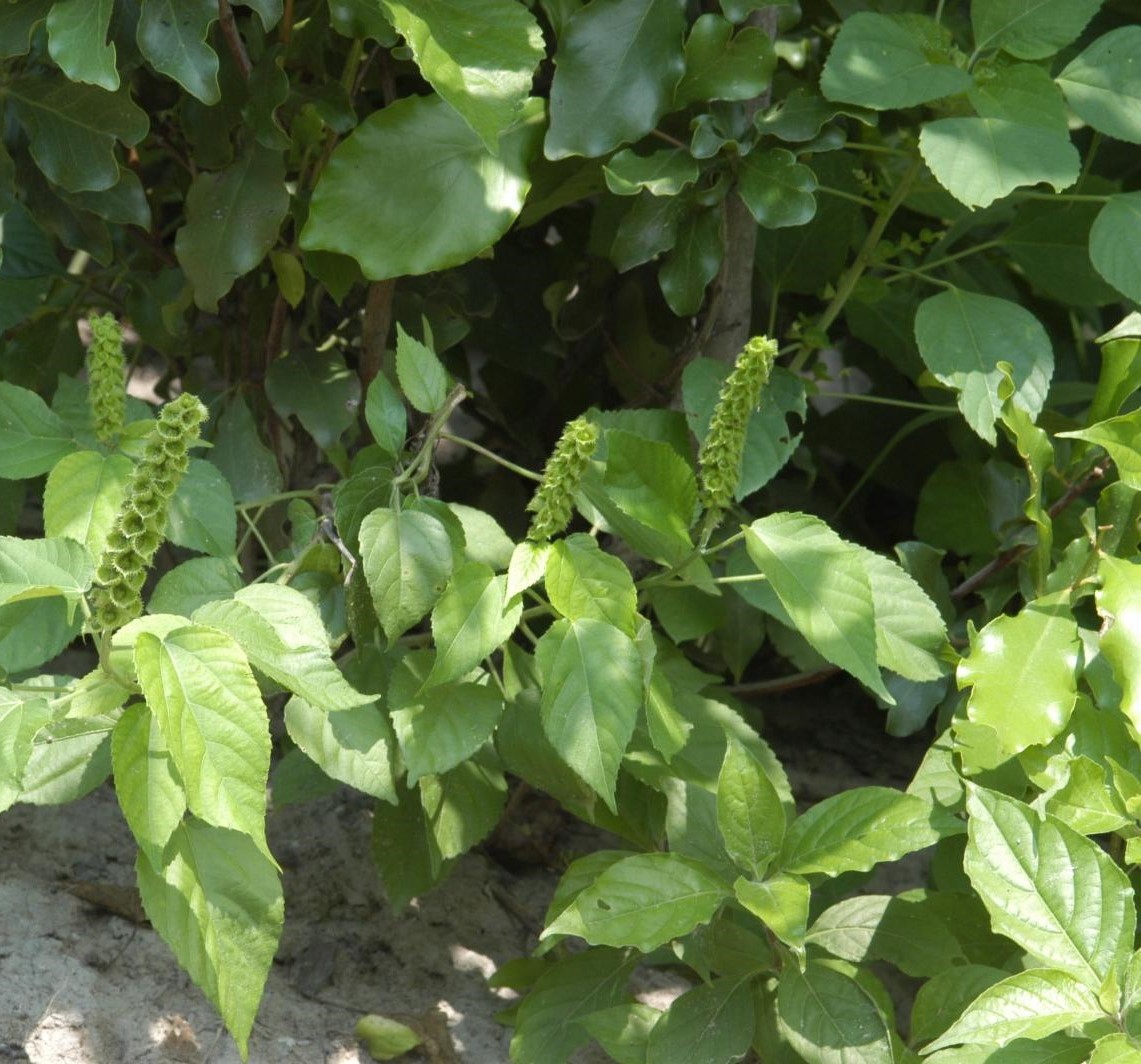
|
|
Acalypha ornata Common Names: Copperleaf, Ornate Acalypha Scientific
Classification Kingdom: Plantae Phylum: Tracheophyta Class: Magnoliopsida Order: Malpighiales Family: Euphorbiaceae Genus: Acalypha Species: Acalypha ornata Synonyms: Acalypha adenotricha A.Rich., Acalypha grantii Baker &
Hutch., Acalypha livingstoniana Müll.Arg., Acalypha moggii Compton, Acalypha
nigritiana Müll.Arg., Acalypha swynnertonii S.Moore, Ricinocarpus adenotrichus
(A.Rich.) Kuntze, Ricinocarpus livingstonianus (Müll.Arg.) Kuntze, Ricinocarpus
nigritianus (Müll.Arg.) Kuntze, Ricinocarpus ornatus. Morphological Description Acalypha ornata is a
robust, much-branched woody herb or shrub, reaching heights of 1–5 meters,
occasionally up to 7 meters in favorable conditions. Its vibrant foliage and
sturdy structure make it ecologically and aesthetically significant. Key
features include: · Stems: Young stems purplish, densely pubescent,
becoming glabrous and woody with age; bark grayish-brown, slightly fissured in
older plants (Flora of Botswana, n.d.). · Leaves: Elliptic-ovate to broadly ovate, 5–16 cm long,
3–10 cm wide, thin-textured, with serrated margins; base rounded to subcordate,
apex acute to acuminate; petioles 2–8 cm long; young leaves bronze, maturing to
glossy green (Useful Tropical Plants, n.d.). · Inflorescences: Monoecious, with unisexual flowers in axillary
or terminal spikes; male spikes slender, 5–15 cm long, densely flowered; female
spikes shorter, 2–5 cm, with 1–3 flowers; flowers small, greenish, with reddish
bracts (Plants of the World Online, n.d.). · Fruit: Capsules, 3–4 mm diameter, 3-lobed, pubescent,
splitting to release small, ovoid seeds, 2–3 mm long, grayish-brown (Flora of
Botswana, n.d.). The shrub’s dense
foliage and colorful young leaves make it a favored ornamental, while its seeds
are dispersed by explosive dehiscence, aiding its spread in disturbed areas
(Useful Tropical Plants, n.d.). Distribution and Habitat Acalypha ornata is
widely distributed across tropical Africa, from Nigeria, Eritrea, and Ethiopia
southward to Angola, Namibia, Malawi, Mozambique, Botswana, Eswatini, and
northern South Africa. It occurs in diverse habitats, including: · Forest
Undergrowth and Edges:
Common in evergreen and riverine forests, often in shaded areas (Plants of the
World Online, n.d.). · Wooded
Grasslands and Thickets:
Thrives in savanna and deciduous woodlands, particularly in rocky or sandy
soils (Flora of Botswana, n.d.). · Disturbed
Areas: Abundant in secondary
regrowth, roadsides, and abandoned farmlands, tolerating human disturbance
(Useful Tropical Plants, n.d.). · Elevation: Sea level to 2,000 meters, with optimal growth
at 500–1,500 meters; annual rainfall of 600–1,500 mm (Flora of Botswana, n.d.). Its adaptability to
varied soils (loamy, sandy, or rocky) and resilience in disturbed ecosystems
make it a pioneer species in degraded landscapes (Useful Tropical Plants,
n.d.). Ethnopharmacology Acalypha ornata is
extensively used in traditional African medicine, particularly in East and West
Africa, for treating skin infections, respiratory ailments, and systemic
conditions. Ethnopharmacological studies confirm its bioactivity, attributed to
flavonoids, tannins, alkaloids, and terpenoids. Key medicinal uses include: · Antimicrobial: Methanol leaf extracts inhibit *Staphylococcus
aureus* (MIC = 50 µg/mL), *Escherichia coli* (MIC = 100 µg/mL), and *Klebsiella
pneumoniae* (MIC = 100 µg/mL), validating use for skin infections, wounds, and
diarrhea; flavonoids and alkaloids are key actives (Onocha et al., 2011). · Anti-inflammatory: Ethanol leaf extracts reduce
carrageenan-induced paw edema in rats by 35% at 200 mg/kg, linked to tannins
and phenolic compounds, justifying use for swelling and leprosy-related
inflammation (Seebaluck et al., 2015). · Antioxidant: Leaf extracts exhibit DPPH radical scavenging
(IC50 = 12.5 µg/mL), attributed to flavonoids and phenolic acids, supporting
use for oxidative stress-related ailments (Onocha et al., 2011). · Respiratory
Health: Leaf infusions are used
in Tanzania for cough and bronchitis; preliminary studies show bronchodilatory
effects in guinea pigs, possibly due to alkaloids (Seebaluck et al., 2015). ⚠ Toxicity Profile: Limited toxicological data exist for Acalypha
ornata, but studies suggest moderate safety with traditional use. Key findings
include: Acute Toxicity: Methanol leaf extracts have an LD50 > 4,000 mg/kg
in mice, indicating low acute toxicity; no cytotoxicity to Vero cells at 150
µg/mL (Onocha et al., 2011). Human Risk: No reported human toxicity cases;
excessive consumption of leaves may cause gastrointestinal upset due to
saponins (Seebaluck et al., 2015). Precautions: Avoid high doses or prolonged
use, especially in pregnancy or lactation, due to limited reproductive toxicity
data. Further studies are needed (Onocha et al., 2011). Additional Uses · Nutritional: Young leaves are consumed as a vegetable in
Tanzania and Malawi, often cooked with groundnuts, coconut milk, or tomatoes,
served with ugali or rice; rich in vitamins A and C (Useful Tropical Plants,
n.d.). · Fiber: Stems are used for weaving baskets and mats in
East Africa, valued for their flexibility and durability (Flora of Botswana,
n.d.). · Fodder: Leaves and young shoots are fed to goats and
cattle, particularly in dry seasons, due to their palatability and nutritional
content (Useful Tropical Plants, n.d.). · Ornamental: Cultivated in gardens for its attractive
bronze-green foliage and compact growth, especially in tropical regions (Flora
of Botswana, n.d.). · Zoopharmacognosy: In Tanzania, wild chimpanzees consume leaves,
possibly for antiparasitic effects, suggesting self-medication (Seebaluck et
al., 2015). Conservation and Sustainability Acalypha ornata is not
currently threatened, with a wide distribution and adaptability to disturbed
areas (IUCN Red List, Least Concern). However, overharvesting of leaves and
stems for medicine and fodder, combined with habitat loss from deforestation,
poses localized risks. Sustainable practices include cultivating the species
from seeds or cuttings and prioritizing leaf harvesting over whole-plant
collection. Its ability to thrive in degraded soils makes it suitable for
agroforestry and habitat restoration (Useful Tropical Plants, n.d.; Flora of
Botswana, n.d.). References
External Links
More Pictures |
|
| Compounds of Acalypha ornata. | |
| References |