Jatropha curcas
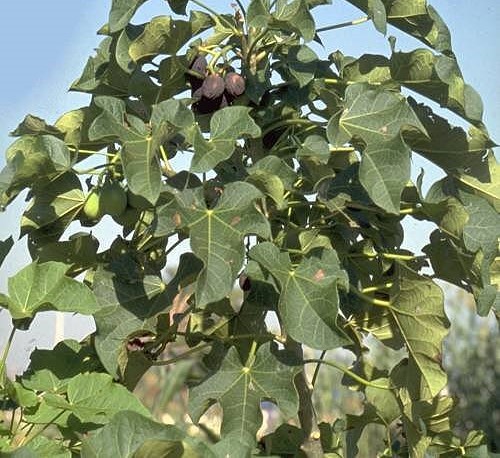
|
|
Jatropha curcas Common Names: Physic
nut, purging nut, Barbados nut Scientific
Classification Kingdom: Plantae Clade: Tracheophytes Clade: Angiosperms Clade: Eudicots Order: Malpighiales Family: Euphorbiaceae Genus: Jatropha Species: Jatropha curcas L. World Flora Online recognizes Jatropha curcas L. as the accepted
name and documents extensive historical synonymy across taxonomic backbones
(Plants of the World Online, n.d.; World Flora Online, n.d.). Morphological Description Jatropha curcas is a perennial shrub or
small tree, commonly 3–6 m tall, with rapid growth and high drought tolerance.
It is typically monoecious, producing male and female flowers within the same
inflorescence. Morphological traits show substantial variation across regions
and cultivation contexts, but diagnostic features include palmately lobed
leaves and capsular fruits with three seeds (Abdelgadir et al., 2013). · Leaves: Large,
green, glabrous to sparsely pubescent, usually 3–5 lobed (Abdelgadir et al.,
2013). · Flowers: Yellowish-green,
arranged in terminal cymes; male flowers usually more numerous than female
flowers (Abdelgadir et al., 2013). · Fruits: Ellipsoidal
capsules turning from green to yellow at maturity; dehiscent when dry
(Abdelgadir et al., 2013). · Seeds: Black,
oily; seed oil content is frequently reported in the 30–35 percent range in
biodiesel-focused literature, with variation by provenance and agronomy
(Devappa et al., 2012). Distribution and Habitat Plants of the World Online describes the native range of Jatropha curcas as
Mexico to tropical America. The species is now widely cultivated and
naturalized across tropical Africa and Asia, where it commonly persists as a
hedge plant and escapes into disturbed habitats. It is strongly associated with
seasonally dry tropical regions and tolerates low fertility soils and
intermittent drought (Plants of the World Online, n.d.; Abdelgadir et al.,
2013). · Biome
association: Seasonally dry tropical environments and warm lowland
tropics (Plants of the World Online, n.d.). · Typical
habitats: Roadsides, hedges, fallow lands, savanna margins, disturbed
ground (Abdelgadir et al., 2013). · Ecological
traits: High drought tolerance, rapid establishment, and persistence
on marginal soils (Abdelgadir et al., 2013). Ethnopharmacology Ethnomedicinal use of Jatropha
curcas spans Africa, Asia, and Latin America. Traditional
practices emphasize topical application of latex and leaf preparations for
wounds, skin infections, and inflammatory lesions, while internal use is
typically described as cautious or limited because the seeds and oil are
recognized as strongly purgative and potentially dangerous.
Ethnopharmacological syntheses document uses for dermatological conditions,
pain, inflammation, gastrointestinal complaints, and infectious syndromes,
though the plant’s toxicity strongly shapes traditional dosing behavior and
preparation choices (Abdelgadir et al., 2013). Wound healing and
dermatological applications: Latex and leaf preparations
are widely used topically in folk medicine. In vitro experiments support a
plausible wound-healing rationale. A latex-extract topical spray formulation
promoted closure in scratch assays using human fibroblast and keratinocyte
models and was also reported to support collagen-related outcomes in vitro,
consistent with traditional wound use (Tinpun et al., 2020). In vivo murine
work also supports wound-phase effects. A latex cream formulation was
associated with reduced inflammatory markers in the wound environment in mice,
interpreted as anti-inflammatory activity during wound healing (Salim et al.,
2018). Another mouse study reported angiogenesis-related activity using CD34
immunoreactivity after topical application of latex cream (Balqis et al.,
2018). Anti-inflammatory and
analgesic activity: A controlled rodent study of aqueous leaf extract reported
significant anti-inflammatory activity in carrageenan-induced paw edema, with
effects comparable to standard anti-inflammatory drugs in the same model, and
analgesic activity in the acetic-acid writhing test, supporting ethnomedical
use for inflammatory pain conditions (Olukunle et al., 2011). Anti-arthritic potential: In an
adjuvant-induced arthritis rat model, an ethanolic leaf extract reduced
arthritis-associated outcomes, including swelling and clinical arthritis
indices, supporting traditional use in joint pain contexts. Interpretation
should consider that arthritis models vary in predictive value for human
disease and that extract composition is preparation-dependent (Baroroh et al.,
2014). Antimicrobial activity
relevant to infected wounds: Antimicrobial
activity has been reported for latex and leaf extracts in vitro, aligning with
traditional use for infected wounds. A recent English-language study reported
latex activity against burn wound pathogens, highlighting possible relevance in
topical wound contexts, although clinical use requires careful formulation
because the plant contains irritant diterpenes and other toxic constituents
(Al-Shami & Alzomor, 2025; Abdelgadir et al., 2013). Additional Uses · Energy
crop: Seed oil is widely investigated as a non-edible biodiesel
feedstock (Devappa et al., 2012). · Environmental
uses: Hedge plant for fencing and erosion control in dryland and
smallholder systems (Abdelgadir et al., 2013). · Industrial
relevance: Investigated as a source of biopesticidal phorbol esters and
other bioactive compounds, although toxicity constrains handling and downstream
use (Devappa et al., 2012). ⚠ Safety and Toxicity: Seeds and seed oil are highly toxic and account for many
documented poisonings. Classic clinical series describe acute gastrointestinal
toxicity in children after seed ingestion, including marked nausea, vomiting,
and diarrhea, with some cases requiring intravenous rehydration but generally
recovering with supportive care (Joubert et al., 1984). Additional reports
across regions similarly describe prominent gastrointestinal symptoms after
accidental seed ingestion (Abdu-Aguye et al., 1986; Gupta et al., 2016).
Phorbol esters are widely regarded as the main toxic principle of the seeds and
oil. Chemical and feeding studies demonstrate that toxicity varies by
provenance and correlates with phorbol ester content (Makkar et al., 1997).
Experimental toxicology work also reports acute toxicity parameters for
isolated phorbol esters in animal models, reinforcing their central role (Li et
al., 2010). Curcin contributes additional cytotoxic potential through protein
synthesis inhibition (Lin et al., 2010). Internal use is not recommended
outside controlled research or specialized clinical supervision. Topical use
should be limited to well-characterized, diluted formulations with attention to
irritation and sensitization risk (Abdelgadir et al., 2013). References
External Links
More Pictures
|
|
| Compounds of Jatropha curcas | |
| References | Murtala Muhammad, Etal. (2023). Phytochemical analysis of Nigerian medicinal plants. NMPP-DB
Project, Department of Biochemistry, Kano University of Science and Technology,
Wudil |
