Eryngium foetidum
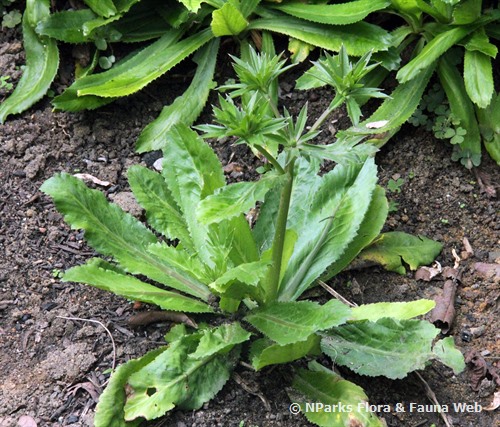
|
|
Eryngium foetidum Common Names: Culantro, Long Coriander, Sawtooth
Coriander, Mexican Coriander, Shadow Beni Scientific
Classification Kingdom: Plantae Clade: Tracheophytes Clade: Angiosperms Clade: Eudicots Clade: Asterids Order: Apiales Family: Apiaceae Genus: Eryngium Species: E. foetidum Binomial Name: Eryngium foetidum L. Synonyms: Eryngium antihystericum Rottb., Eryngium foetidum var. antihystericum (Rottb.) A. Dietr. Morphological Description Eryngium foetidum is a tropical perennial or biennial herb, typically 15–50 cm
tall, forming a basal rosette. Key features include: · Stems: Short, thick, often branching from the base · Leaves: Oblanceolate, 10–30 cm long, 2–4 cm wide, serrated edges,
dark green, pungent when crushed · Flowers: Small, white to greenish, in cylindrical heads, 1–2 cm long,
subtended by spiny bracts · Fruit: Ovoid, scaly, 1–2 mm long, containing small seeds Its strong odor,
attributed to volatile compounds like eryngial, explains the epithet
"foetidum" (Paul et al., 2011). Distribution and Habitat Eryngium foetidum thrives in: · Native Range: Mexico, Central America, northern South America · Introduced Range: Caribbean, Southeast Asia, West Africa,
India, Pacific Islands · Habitat: Shady or semi-shaded areas, moist soils, forest edges,
pastures; 0–1,000 m altitude · Climate: Tropical, humid, 25–35°C, rainfall 1,200–2,500 mm It is cultivated
globally, often as an annual in temperate zones (PROTA, 2019). Ethnopharmacology Eryngium foetidum is widely used traditionally, with studies validating some
claims: · Skin Disorders/Stings: Leaf poultice in Trinidad; antibacterial
against S. aureus (MIC
0.5 mg/mL) (Singh et al., 2016). · Anti-inflammatory/Analgesic: Leaf decoction in Jamaica; reduces edema
in rats (40% at 200 mg/kg) (Simon & Singh, 1986). · Colds/Fevers: Leaf infusion in Thailand; antipyretic in mice (30% at 300
mg/kg) (Mekhora et al., 2012). · Digestive Issues: Leaf tea in Brazil; antisecretory effect
(50% at 400 mg/kg) (Leitão et al., 2023). · Epilepsy: Known as "spiritweed" in Jamaica; anticonvulsant
in rats (50% seizure reduction at 200 mg/kg) (Simon & Singh, 1986). · Antioxidant: Leaf extract in Colombia; scavenges ROS (IC₅₀ 45 µg/mL)
(Leitão et al., 2023). ⚠ Toxicity Profile: Safe at <500 mg/kg (LD₅₀ > 2,000 mg/kg in mice); high doses
(3.2% diet) may cause kidney lesions after 24 weeks (Janwitthayanuchit et al.,
2016). Additional Information · Culinary Uses: Flavoring in Caribbean (e.g., Trinidad’s chadon beni sauce),
Southeast Asian (e.g., Vietnamese pho), and Amazonian dishes; stronger than
cilantro (Ramcharan, 1999). · Cultural Significance: Integral to Trinidadian cuisine and
rituals; used in India’s Northeast as a coriander substitute (Singh et al.,
2014). · Other Uses: Ornamental due to serrated leaves; dries well for spice
trade (PROTA, 2019). References
External Links More Pictures |
|
| Compounds of Eryngium foetidum | |
| References |