Eclipta prostrata
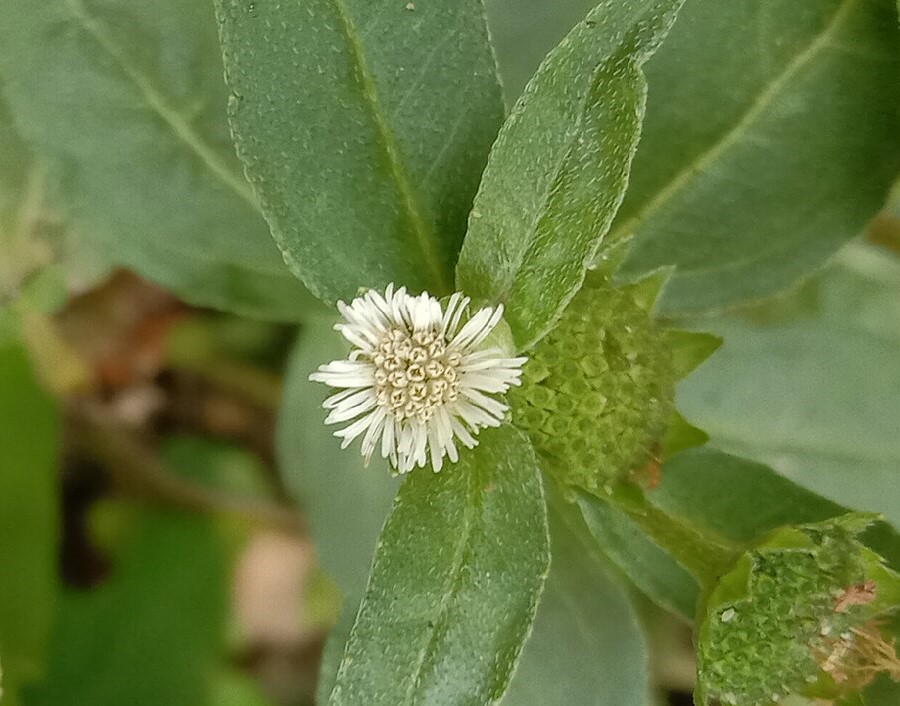
|
|
Eclipta prostrata Common Names: False daisy, Bhringraj, Yerba de tago,
Karisalankanni Scientific
Classification Kingdom: Plantae Clade: Tracheophytes Clade: Angiosperms Clade: Eudicots Clade: Asterids Order: Asterales Family: Asteraceae Genus: Eclipta Species: E. prostrata Synonyms: Eclipta alba (L.) Hassk., Verbesina prostrata L., Eclipta erecta L., Eclipta punctata L., Verbesina alba L., Eclipta dichotoma Raf., Eclipta zippeliana Blume, among others (full list available
at Kew Science) Morphological Description Eclipta prostrata is an annual or short-lived perennial herb, prostrate to
ascending, typically 10–90 cm tall, occasionally reaching 120 cm. Its key
characteristics include: · Roots: Cylindrical, grayish, fibrous, well-developed, anchoring in
moist soils (Burkill, 1985). · Stems: Solid, purplish, cylindrical or slightly flattened, with
fine white appressed hairs; often rooting at nodes (Fern, 2024). · Leaves: Opposite, sessile to subsessile, lanceolate to oblong
(2–12.5 cm × 0.5–3.5 cm), serrated, hairy on both surfaces, dark green (Prance
& Jongkind, 2015). · Flowers: Solitary or paired heads (6–8 mm diameter), white to pale
yellow florets, in axillary or terminal inflorescences; bloom year-round in
tropics (Kew Science, n.d.). · Fruit: Compressed, narrowly winged achenes (2–3 mm), black to
brown, bumpy, dispersed by water or adhesion (Fern, 2024). Distribution and Habitat Eclipta prostrata is a cosmopolitan species, thriving in diverse environments: · Geographic Range: Native to tropical and subtropical Asia,
Africa, and the Americas; widespread in Nigeria, India, China, Nepal, Brazil,
Indonesia, Malaysia, and Australia; naturalized in temperate regions (Kew
Science, n.d.). · Habitat: Grows in moist environments like wetlands, riverbanks, rice
fields, ditches, and disturbed areas; prefers loamy or clay soils (pH 5.0–7.5)
with high organic matter; tolerates flooding and elevations up to 2,000 m
(Fern, 2024). · Ecological Role: Considered a weed in agriculture; supports
pollinators like bees; stabilizes soil in wetlands; can become invasive in
favorable conditions (Burkill, 1985). Ethnopharmacology Eclipta prostrata, known as Bhringraj in Ayurveda, is a cornerstone of traditional
medicine across Asia, Africa, and South America, with extensive
ethnopharmacological validation (Feng et al., 2019): · Hepatoprotective: In Nigeria, leaf decoctions treat jaundice
and hepatitis. Methanolic leaf extract (250 mg/kg) protected rat livers from
carbon tetrachloride-induced damage, reducing serum transaminases (ALT, AST) by
40–50%, attributed to wedelolactone and flavonoids (Saxena et al., 1993). · Hair Growth Promotion: In Nigeria and India, leaf extracts are applied
to scalps for hair growth. Petroleum ether extract (5%) increased hair follicle
count and length in rats, comparable to minoxidil, due to coumestans like
wedelolactone (Datta et al., 2009). · Anticancer: Whole plant extracts are used for tumors in Nigeria.
Hydro-alcoholic leaf extract inhibited HTLV-1-infected cell lines (MT-1, MT-2)
with EC50 of 0.1–1 µg/mL, linked to eclalbasaponins and coumestans (Chaudhary
et al., 2011). · Antimicrobial: Leaf decoctions treat skin infections in Nigeria. Methanolic
leaf extract inhibited Staphylococcus aureus and Escherichia coli (MIC: 0.5–2 mg/mL), with thiophene derivatives and
flavonoids as active compounds (Karthikumar et al., 2007). · Anti-inflammatory: In Nigeria, leaves are used for wounds.
Wedelolactone (10 µM) inhibited NF-κB-mediated inflammation in RAW264.7 cells,
reducing iNOS, COX-2, and TNF-α expression, supporting use for arthritis and
skin inflammation (Jahan et al., 2014). · Antidiabetic: Leaf infusions manage diabetes in Nigeria. · Antioxidant: Whole plant is used to combat oxidative stress. Water
extract showed DPPH scavenging (IC50: 2.8 µg/mL), attributed to phenolic acids
(caffeic, chlorogenic) and flavonoids (quercetin, luteolin) (Chan et al.,
2014). ⚠ Toxicity Profile: Eclipta prostrata is generally safe at therapeutic doses,
with no significant toxicity reported in traditional use. Acute toxicity
studies showed no mortality in rats at methanolic leaf extract doses up to
2,000 mg/kg (LD50 > 2,000 mg/kg). Sub-chronic use may cause mild liver
enzyme elevation (ALT increased by 10%). High doses (>1,000 mg/kg) may cause
gastrointestinal discomfort. Use is contraindicated in pregnancy and for
children due to insufficient safety data. Allergic reactions (e.g., contact
dermatitis) may occur in sensitive individuals (Feng et al., 2019). Additional Uses · Culinary: In Nigeria and Indonesia, young leaves are cooked as a
vegetable or used in salads (Burkill, 1985). · Cosmetic: Leaf extracts are used in Nigeria for black hair dye and
tattoo ink; infused in coconut oil for hair care (Fern, 2024). · Pesticidal: Aqueous leaf extracts deter Culex quinquefasciatus larvae, attributed to saponins (Fern,
2024). · Cultural: In Nigeria, leaves are used in rituals for spiritual
cleansing; revered as “King of Hair” in Ayurveda (Burkill, 1985). References
External Links More Pictures |
|
| Compounds of Eclipta prostrata | |
| References | Murtala
Muhammad, Etal. (2023). Phytochemical
analysis of Nigerian medicinal plants. NMPP-DB Project, Department of Biochemistry,
Kano University of Science and Technology, Wudil |