Lonchocarpus sericeus
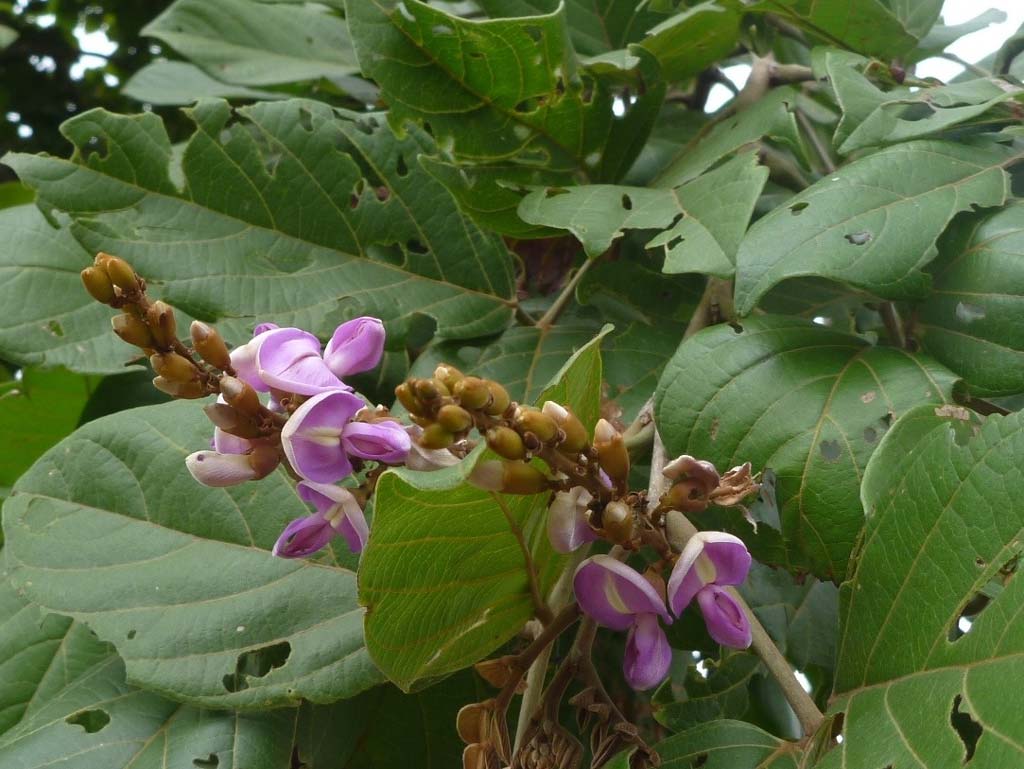
|
|
Lonchocarpus sericeus Common Names: Dotted Lancepod, Lilac Tree, Senegal
Lilac Scientific
Classification Kingdom: Plantae Phylum: Tracheophyta Class: Magnoliopsida Order: Fabales Family: Fabaceae Genus: Lonchocarpus Species: L. sericeus Authority: (Poir.) Kunth ex DC. Synonyms: Millettia sericea Wight & Arn., Derris sericea (Poir.) Ducke Morphological Description Lonchocarpus sericeus is an evergreen shrub or small tree in the Fabaceae family,
typically growing 4–20 m tall with a roundish crown: · Stem: Straight, cylindrical bole 30–70 cm in diameter, bark
greyish-brown, smooth or slightly fissured (Fern, 2024). · Leaves: Pinnately compound, alternate, 10–25 cm long; 5–9 leaflets,
elliptic to obovate, 3–8 cm long, silky-hairy beneath (Burkill, 1995). · Flowers: Purple to lilac, pea-like, 1–1.5 cm long, in dense axillary
or terminal racemes up to 15 cm long (Orwa et al., 2009). · Fruits: Flat, indehiscent pods, 5–10 cm long, 1–2 cm wide,
containing 1–4 kidney-shaped seeds (Fern, 2024). Distribution and Habitat Lonchocarpus sericeus is native to tropical Africa and extends to other regions
through cultivation: · Range: Senegal, Nigeria, Cameroon, DR Congo, Uganda, Tanzania;
introduced to India, Caribbean (Burkill, 1995). · Habitat: Secondary forests, forest edges, savannah woodlands,
riverbanks; thrives in well-drained soils, 0–1,200 m altitude (Fern, 2024). Ethnopharmacology Lonchocarpus sericeus, commonly known as Senegal lilac or cube
root, is a leguminous plant recognized for its diverse medicinal properties.
Traditionally, its bark has been used as a laxative, aiding in relieving
constipation. Scientific studies have substantiated several therapeutic
benefits of this plant. The stem bark extract exhibits significant
anti-inflammatory and analgesic activities, attributed to bioactive compounds
such as flavonoids, alkaloids, and saponins, validating its traditional use in
managing pain and inflammation. Additionally, the leaves demonstrate
hepatoprotective effects, enhancing antioxidant potential in the liver and
blood, which may be related to their phenolic content, offering protection
against liver damage. Furthermore, the plant's lectin has been found to
decrease leukocyte migration and mechanical hypernociception by inhibiting
cytokine and chemokine production, indicating potential in modulating immune
responses. These findings underscore the therapeutic potential of Lonchocarpus
sericeus in various medicinal applications. · Anticonvulsant: Root decoctions in Nigeria for
convulsions; In a study evaluating the anticonvulsant properties of a specific
fraction (ISO mg/kg) of Lonchocarpus sericeus root extract, it was found that
this fraction provided 50% protection against pentylenetetrazole-induced
seizures in mice, whereas sodium valproate, a standard antiepileptic drug,
offered complete (100%) protection. In the 4-aminopyridine-induced seizure
model, the fraction at doses of 75 and 300 mg/kg protected 33.3% of the animals
from mortality, while phenobarbitone (20 mg/kg) provided full protection. The
fraction showed no activity against maximal electroshock-induced convulsions.
Phytochemical screening revealed the presence of phenolic compounds, flavonoids,
triterpenoids, and steroids. The intraperitoneal LD₅₀ of the fraction was
determined to be 1131.3 mg/kg (Abdullahi et al., 2012). · Skin Diseases: Leaf poultices in Ghana for sores; ethanol extract
inhibited Staphylococcus aureus (MIC 0.5 mg/mL) (Agyare et al., 2013). · Laxative and Anti-inflammatory: Root bark in Cameroon ad Senegal are used
on swelling; The crude extract and fractions (310-930 mg/kg) effectively
reduced oedema caused by egg albumin and xylene and exhibited high analgesic
properties in inhibiting pain induced by acetic acid and heat. These reductions
were dose-dependent and statistically significant (p<0.05-0.001) when
compared to distilled water and similar to prototype drugs employed (Emmanuel
et al., 2020). ⚠ Toxicity Profile: Contains rotenoids; high doses (>500 mg/kg)
of root extract caused tremors and liver damage in rats; safe at low doses per
genotoxicity tests (Hong et al., 2009). Additional Uses · Timber/Fuel: Hardwood used for construction, fuelwood; harvested locally
(Orwa et al., 2009). · Ornamental: Planted in urban areas for its lilac flowers and shade
(Fern, 2024). · Ecological: Nitrogen-fixing; improves soil fertility in agroforestry
(Burkill, 1995). References
External Links More Pictures
|
|
| Compounds of Lonchocarpus sericeus | |
| References |