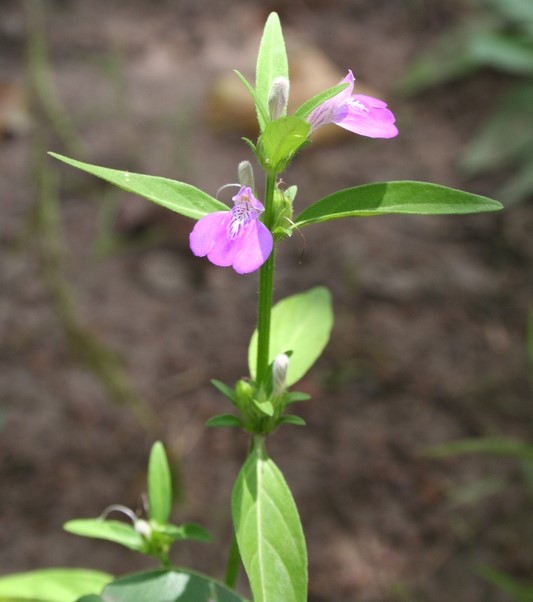
Justicia insularis

Justicia insularis

Justicia insularis

Common Names: 
Local Names: Obe dudu (Yoruba, Nigeria), Kpalakokoi (Ewe, Ghana), Mien-Mien (Bamoun, Cameroon), Budidiyo (Hausa, Nigeria),Shigel Kirgegu(Kanuri, Nigeria)
Species ID: NMP-092 |
wfo-0000353617

Scientific Classification

Kingdom: Plantae

Phylum: Tracheophyta

Class: Magnoliopsida

Order: Lamiales

Family: Acanthaceae

Genus: Justicia

Species: J. insularis

Authority: T.Anderson

Synonyms: Adhatoda diffusa Benth., Justicia karschiana Büttner, Justicia rostellarioides Lindau, Justicia striatainsularis (T.Anderson) J.K.Morton

Morphological Description

Justicia insularis is a versatile herbaceous plant in the Acanthaceae family, growing as an annual or perennial up to 0.3–2 m tall:

·       Stem: Erect to sprawling, quadrangular, pubescent with fine hairs, branching up to 1 m wide (Fern, 2024).

·       Leaves: Simple, opposite, linear to ovate, 3–10 cm long, 1–4 cm wide, glabrous or slightly pubescent, apex rounded or acute (Burkill, 1985).

·       Flowers: Crimson to purple, tubular, 1.5–2 cm long, in dense axillary or terminal spikes; calyx lanceolate, corolla tube widening apically (Telefo et al., 2012).

·       Fruits: Glabrous capsules, 1–1.5 cm long, four-seeded, surface reticulate-rugose (Fern, 2024).

Distribution and Habitat

Justicia insularis is widespread across intertropical Africa:

·       Range: Senegal, Nigeria, Ghana, Cameroon, Central African Republic, Sudan, Uganda (Burkill, 1985).

·       Habitat: Waste areas, roadsides, disturbed sites, grassy savannahs; thrives in moist soils during rainy season, 0–1,500 m altitude (Fern, 2024).

Ethnopharmacology

Justicia insularis has been traditionally used for its medicinal properties, including serving as a digestive aid, laxative, and weaning agent. Recent studies have identified bioactive compounds such as clerodane diterpenoids, which may contribute to its therapeutic effects. Research indicates that extracts from J. insularis exhibit significant analgesic and anti-inflammatory activities, supporting its traditional use in managing pain and inflammation. Additionally, the plant has demonstrated notable antioxidant properties and potential estrogenic effects, such as inducing early vaginal opening and increasing ovarian weight in animal studies. Beyond its medicinal applications, J. insularis is consumed as a leafy vegetable in certain West African regions, highlighting its nutritional value.

·       Fertility Enhancement: Leaf infusions in Cameroon for female infertility; aqueous extract (100 mg/kg) increased ovarian weight and folliculogenesis in rats by 30% (Telefo et al., 2012).

·       Snakebite Treatment: Flowers crushed in Nigeria for venomous bites.

·       Antimicrobial: Leaf decoctions in Ghana for infections; ethanol extract inhibited Escherichia coli (MIC 0.25 mg/mL) (Agyare et al., 2013).

·       Pain Relief: Leaves in Togo for labor pains

⚠  Toxicity Profile: High doses (100 mg/kg) of aqueous extract increased pre- and post-implantation losses in rats by 40%, suggesting reproductive toxicity; caution advised in pregnancy (Telefo et al., 2012).

Additional Uses

·       Culinary: Young leaves cooked as a vegetable in Nigeria and Cameroon, rich in protein and minerals (Burkill, 1985).

·       Ecological: Used as a cover crop in agroforestry to prevent soil erosion (Fern, 2024).

·       Cultural: Flowers used in rituals for protection against snakebites in West Africa

References

  • Achigan-Dako, E. G., Pasquini, M. W., Assogba-Komlan, F., N’danikou, S., Yédomonhan, H., Dansi, A., & Ambrose-Oji, B. (2010). Traditional vegetables in Benin: Diversity, distribution, ecology, agronomy, and utilization. International Journal of Biodiversity and Conservation, 2(2), 29–43. https://doi.org/10.5897/IJBC.9000012
  • Agyare, C., Boakye, Y. D., Bekoe, E. O., Hensel, A., Dapaah, S. O., & Appiah, T. (2013). Review: African medicinal plants with wound healing properties. Journal of Ethnopharmacology177, 85–100. https://doi.org/10.1016/j.jep.2015.11.008
  • Burkill, H. M. (1985). The useful plants of West Tropical Africa (Vol. 1). Royal Botanic Gardens, Kew.
  • Burkill, H. M. (1985). The useful plants of West Tropical Africa (Vol. 1). Royal Botanic Gardens, Kew.​
  • Fern, K. (2024). Justicia insularis. Useful Tropical Plants Database. Retrieved from http://tropical.theferns.info/viewtropical.php?id=Justicia+insularis
  • Govaerts, R. (2024). Justicia insularis. In Plants of the World Online. Royal Botanic Gardens, Kew. Retrieved from https://powo.science.kew.org/taxon/urn:lsid:ipni.org:names:50905-1
  • Iwu, M. M. (1993). Handbook of African medicinal plants. CRC Press.
  • Konaté, K., Bassolé, I. H. N., Hilou, A., & Dicko, M. H. (2015). Analgesic and anti-inflammatory activities of Justicia insularis T. Anders (Acanthaceae). Pharmacognosy Research, 7(1), 49–54. https://doi.org/10.4103/0974-8490.147202​
  • Konaté, K., Hilou, A., Mavoungou, J. F., Lepengué, A. N., Souza, A., Barro, N., ... & Nacoulma, O. G. (2012). Antimicrobial activity of polyphenol-rich fractions from Justicia anselliana (Nees) T. Anders (Acanthaceae). Journal of Intercultural Ethnopharmacology, 1(1), 1–6. https://doi.org/10.5455/jice.20120428012015
  • Telefo, P. B., Moundipa, P. F., & Tchouanguep, F. M. (2012). Effect of the aqueous extract of Justicia insularis T. Anders (Acanthaceae) on ovarian folliculogenesis and fertility of female rats. African Journal of Traditional, Complementary and Alternative Medicines9(2), 197–203. https://doi.org/10.4314/ajtcam.v9i2.3
  • Telefo, P. B., Moundipa, P. F., & Tchouanguep, F. M. (2002). Oestrogenicity and effect on hepatic metabolism of the aqueous extract of the leaf mixture of Aloe buettneri, Dicliptera verticillata, Hibiscus macranthus, and Justicia insularis. Fitoterapia, 73(6), 472–478. https://doi.org/10.1016/S0367-326X(02)00177-6​
  • Telefo, P. B., Moundipa, P. F., & Tchouanguep, F. M. (1998). Effects of an aqueous extract of Aloe buettneri, Justicia insularis, Hibiscus macranthus, and Dicliptera verticillata on some physiological and biochemical parameters of reproduction in immature female rats. Journal of Ethnopharmacology, 63(3), 193–200. https://doi.org/10.1016/S0378-8741(98)00062-2​

External Links

More Pictures


Compounds of Justicia insularis
References

Enyiekere, V. J., Asanga, E. E., Okokon, J. E., Ekeleme, C. M., Anagboso, M. O., & Uduak, I. P. (2024). Fatty Acid Esters and Acyclic Monoterpenoid from Justicia insularis Leaf Fractions Attenuated Malaria Pathogenesis Through Docking with Plasmodium falciparum Serine Hydroxymethyl Transferase and Plasmodium falciparum Erythrocyte Membrane Protein 1 Proteins. Natural Product Communications, 19(7), 1934578X241264995.

Umoh, R. A., Asanga, E. E., Thomas, P. S., Umoh, U. F., Johnny, I. I., Essiett, U. A., ... & Joseph, A. (2025). Isolation of a Lauryl alcohol (1-Dodecanol) from the antioxidant bioactive fractions of Justicia insularis (Acanthaceae) leaves. Natural Product Communications, 20(1), 1934578X241297510.