Globimetula braunii
|
|
Globimetula braunii Common Names: African mistletoe, Powder-bark mistletoe Scientific
Classification Kingdom: Plantae Clade: Tracheophytes Clade: Angiosperms Clade: Eudicots Order: Santalales Family: Loranthaceae Genus: Globimetula Species: G. braunii Synonyms: Loranthus braunii Engl., Globimetula unguiformis (Engl.) Tiegh., Globimetula zenkeri (Engl.) Tiegh. Morphological Description Globimetula braunii is a hemiparasitic shrub, typically attaching to host trees
via haustoria. Its key characteristics include: · Stems: Woody, branching, green when young, becoming greyish-brown; attaches
to hosts like Piliostigma thonningii or Cola acuminata (Burkill,
1985). · Leaves: Opposite or subopposite, fleshy, elliptic to oblong (4–10 cm
× 1.5–7 cm), reddish when young, maturing to light or dark green; petioles
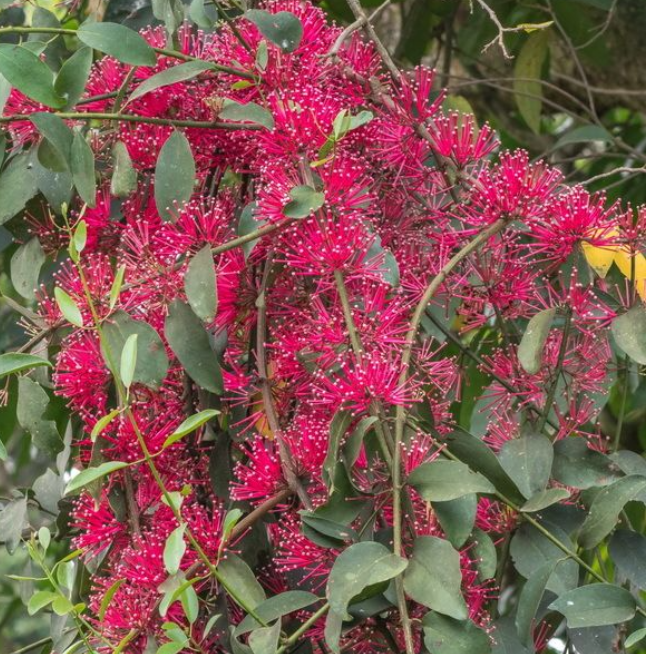
short. · Flowers: Red or pink, tubular, in umbels of 3–6 at older, leafless
nodes; corolla with an apical swelling, darkening in mature buds (Prance &
Jongkind, 2015). · Fruit: Orange or red berries (5–6 mm), fleshy, containing a single
seed; dispersed by birds (Kew Science, n.d.). Distribution and Habitat Globimetula braunii is widely distributed across tropical Africa, thriving in
diverse ecological niches: · Geographic Range: Native to West and Central Africa,
including Nigeria, Ghana, Guinea, Ivory Coast, Cameroon, Togo, Benin, and DR
Congo; common in Nigeria’s forested regions (Kew Science, n.d.). · Habitat: Grows in moist, shady environments, parasitizing host trees
in lowland rainforests, secondary forests, and savanna woodlands; prefers
elevations up to 1,200 m. · Ecological Role: As a hemiparasite, it extracts water and
nutrients from hosts, influencing forest dynamics; supports biodiversity by
providing food for birds (Burkill, 1985). Ethnopharmacology Globimetula braunii is extensively used in West African traditional medicine, with
robust ethnopharmacological validation for multiple ailments (Le et al., 2009): · Anticonvulsant: In Nigeria, leaf decoctions treat
epilepsy. Ethyl acetate fraction of ethanol leaf extract delayed seizure onset
in pentylenetetrazole-induced seizures in mice, attributed to flavonoids,
tannins, and steroids (Aliyu et al., 2014). · Oxytocic: In Nigeria, leaf extracts augment labor. Aqueous leaf
extract (640 mg/mL) induced uterine contractions in rats, similar to oxytocin
(2.7 × 10⁻⁴ mg/mL), inhibited by atropine and salbutamol, confirming
traditional use to hasten delivery (Le et al., 2011). · Antimalarial: In Nigeria, leaf infusions treat malaria. N-hexane fraction
of methanol leaf extract reduced Plasmodium berghei parasitemia in mice, with friedelan-3-one
as a key antiplasmodial compound (Olanlokun et al., 2021). · Antilipemic/Hypocholesteremic: In Nigeria, leaf extracts lower
cholesterol. Methanolic leaf extracts (400 mg/kg) reduced total cholesterol,
triglycerides, and LDL-cholesterol in hypercholesteremic rats, increasing
HDL-cholesterol, indicating cardioprotective potential (Le et al., 2009). · Laxative: In Nigeria, leaf decoctions relieve constipation. Methanolic
leaf extracts exhibited laxative activity, supporting traditional use, though
specific mechanisms are not fully elucidated (Le et al., 2011). · Antioxidant: Leaf extracts show high hydroxyl radical scavenging
activity, supporting use for oxidative stress-related conditions, though
specific studies are limited (Adesina et al., 2013). ⚠ Toxicity Profile: Globimetula braunii is generally safe at therapeutic doses.
Acute toxicity studies showed no mortality in rats at aqueous leaf extract
doses up to 2,000 mg/kg. Sub-chronic dosing (400 mg/kg for 28 days) caused no
significant hematological or biochemical changes, though mild liver enzyme
elevation (ALT increased by 10%) was noted. High doses (>1,000 mg/kg) may
cause gastrointestinal discomfort. Use is contraindicated in pregnancy due to
oxytocic effects and for children due to insufficient safety data. Potential
heavy metal contamination in wild-harvested plants requires caution (Le et al.,
2009). Additional Uses · Cultural: In Yoruba culture, leaf infusions are used in rituals for
spiritual cleansing and health (Burkill, 1985). · Ecological: As a hemiparasite, it influences host tree health and
supports bird-mediated seed dispersal, enhancing forest biodiversity. · Agricultural: Occasionally used as fodder in dry seasons, though its
impact on livestock is not well-studied (Burkill, 1985). References
External Links More Pictures |
|
| Compounds of Globimetula braunii | |
| References | Murtala
Muhammad, Etal. (2023). Phytochemical
analysis of Nigerian medicinal plants. NMPP-DB Project, Department of Biochemistry,
Kano University of Science and Technology, Wudil |