Bauhinia monandra
|
|
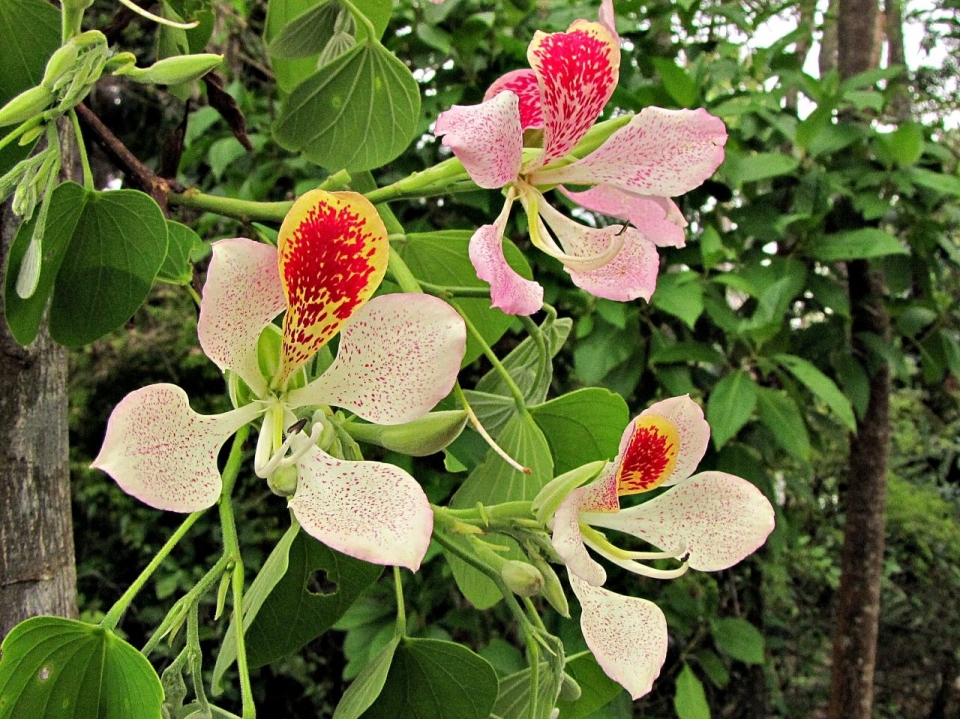
Bauhinia monandra Common Names: Napoleon’s Plume, Pink Bauhinia, St.
Thomas Tree, Orchid Tree Scientific Classification Kingdom: Plantae Phylum: Tracheophyta Class: Magnoliopsida Order: Fabales Family: Fabaceae Genus: Bauhinia Species: B. monandra Synonyms: Bauhinia kappleri Sagot, Bauhinia krugii Urb., Bauhinia porosa Baill., Bauhinia punctiflora Baker, Caspareopsis monandra (Kurz) Britton & Rose Basic Description Bauhinia monandra, commonly known as Napoleon’s Plume or Pink Bauhinia, is a
fast-growing, evergreen shrub or small tree, typically reaching 3–15 m in
height, with a rounded crown. Its key features include: · Bark: Smooth, grey when young, turning reddish-brown with age · Leaves: Bilobed, butterfly-shaped, 7–20 cm long and wide, green,
split into two rounded lobes · Flowers: Showy, 5–7 cm wide, with five petals (four pale pink or
whitish with darker pink/reddish-purple spots, one vivid pink), single
prominent stamen, borne in racemes · Fruit: Flattened pod, 15–22 cm long, 2–3 cm wide, dark brown,
containing 10–20 flat seeds The plant’s continuous
flowering and ornamental foliage make it a favorite in tropical landscaping
(Fern, 2024). Distribution and Habitat Bauhinia monandra is native to Madagascar but widely cultivated and
naturalized in tropical regions, including Myanmar, Australia, the Caribbean,
southern USA, Colombia, Brazil, Nigeria, Ghana, and Pacific Islands. It thrives
in: · Ecosystems: Urban gardens, streetscapes, forest edges, open woodlands,
and waste places · Climate: Tropical, with rainfall of 800–2,000 mm annually and
temperatures of 20–35°C · Soils: Well-drained, sandy to loamy, tolerating moderate drought · Altitude: Sea level to 1,000 m Ethnopharmacology Bauhinia monandra, commonly known as Napoleon’s plume or orchid tree, is a
medicinal plant used in various traditional medicine systems, particularly in
tropical and subtropical regions. Its leaves, bark, flowers, and seeds are
employed for their antimicrobial, antioxidant, antidiabetic, anti-inflammatory,
antihypertensive, and analgesic properties. Traditionally, decoctions or
infusions of the leaves and bark are used to manage diabetes, hypertension,
wounds, skin infections, ulcers, and digestive issues. The plant is also noted
for its potential in reducing blood sugar levels, and its antioxidant activity
helps combat oxidative stress linked to chronic diseases. Phytochemical
investigations have revealed the presence of flavonoids, tannins, saponins,
alkaloids, and phenolic compounds, which are believed to be responsible for its
therapeutic effects. While promising, more detailed scientific and clinical
research is needed to fully validate its traditional uses and ensure safe
medicinal application. · Antidiabetic Activity: In Brazil, methanol leaf extracts reduced
blood glucose by 60% in streptozotocin-induced diabetic rats at 500 mg/kg,
attributed to flavonoids like kaempferitrin, supporting its use for diabetes
management (Mendes et al., 2010). · Anti-inflammatory Effects: use for arthritis and inflammation. · Antimicrobial Activity: Ethanol leaf extracts inhibited Staphylococcus aureus (MIC 0.058 mg/mL) and Escherichia coli (MIC 0.5 mg/mL), confirming its use for
infections and wound healing (Ahmed et al., 2014). · Laxative Properties: In Nigeria, pounded pod decoctions
increased intestinal motility by 50% in rats at 300 mg/kg, validating its use
as a laxative (Burkill, 1995). · Antipyretic and Antiviral Effects: Root decoctions reduced fever in rats by
1.5°C at 400 mg/kg, supporting its use for fevers and smallpox treatment (Samie
et al., 2010). · Antileprotic Activity: Bark decoctions is traditional use for
leprosy . The presence of
flavonoids, triterpenoids (e.g., lup-20(29)-en-3β,24-diol), and phenolic
compounds like methyl gallate underpins these effects (Nworie & Okorie,
2018). ⚠ Toxicity Profile: Acute toxicity studies of methanolic leaf
extracts showed an LD₅₀ >5,000 mg/kg in rats, indicating low acute toxicity.
Subacute administration at high doses (>1,000 mg/kg) may cause mild liver
and kidney stress. Seeds contain hydrogen cyanide (0.32 mg/100g), posing risks
of neurological, respiratory, cardiovascular, and thyroid issues with chronic
exposure; proper processing (e.g., roasting) is essential before consumption.
Pregnant rats showed no maternal or fetal toxicity at doses up to 7,000 mg/kg,
but caution is advised for subacute use in diabetes treatment ( Nworie &
Okorie, 2018; Mendes et al., 2010). Additional Uses · Ornamental: Planted for its continuous, vibrant flowering in tropical
gardens, parks, and as a street tree; valued for shade and aesthetic appeal
(Fern, 2024). · Ecological: Attracts pollinators like bees and butterflies; seeds are
dispersed by birds and mammals, contributing to biodiversity. · Cultural: In Nigeria, leaf infusions are used in rituals for healing
and protection; in Brazil, it is known as “Pata-de-vaca” for its leaf shape
(Burkill, 1995). · Nutritional: Seeds, after processing to remove cyanogenic compounds, are
consumed in small quantities as a protein source (18–20%) (Nworie & Okorie,
2018). References
External Links More Pictures |
|
| Compounds of Bauhinia monandra | |
| References | Murtala Muhammad, Etal. (2023). Phytochemical analysis of Nigerian medicinal plants. NMPP-DB
Project, Department of Biochemistry, Kano University of Science and Technology,
Wudil |