Bauhinia galpinii
|
|
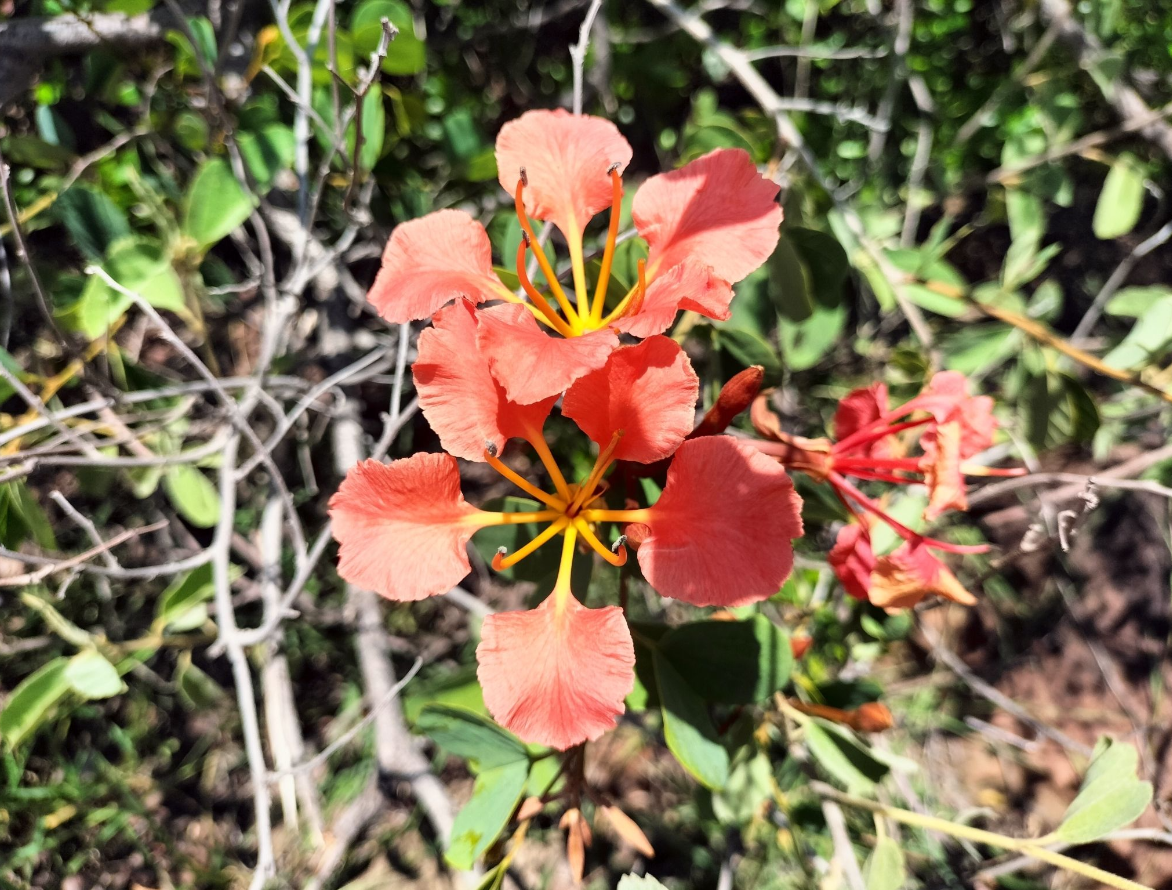
Bauhinia galpinii Common Names: Red Bauhinia, Pride of De Kaap, Red
Orchid Tree Scientific
Classification Kingdom: Plantae Phylum: Tracheophyta Class: Magnoliopsida Order: Fabales Family: Fabaceae Genus: Bauhinia Species: B. galpinii Synonyms: Perlebia galpinii (N.E.Br.) A.Schmitz, Bauhinia punctata sensu Bolle Description Bauhinia galpinii, commonly known as Red Bauhinia or Pride of De Kaap, is a
semi-deciduous, scandent shrub or small tree, typically growing 1–3 m tall,
occasionally reaching 6 m with support. Its key features include: · Bark: Grey to brown, smooth to slightly fissured · Leaves: Bilobed, butterfly-shaped, 3–7 cm long, 4–9 cm wide, green,
with a notched apex · Flowers: Bright red to orange, 5–7 cm wide, borne in terminal or
axillary racemes, blooming February–June · Fruit: Narrow, brown pod, 8–15 cm long, containing 4–8 flat seeds Distribution and Habitat Bauhinia galpinii is native to eastern and southern Africa, including Angola,
Mozambique, Zimbabwe, Eswatini, South Africa, and southern Zambia. It thrives
in: · Ecosystems: Rainforest understories, swamp forests, forest clearings,
savanna woodlands, and rocky slopes · Climate: Tropical to subtropical, with rainfall of 500–1,500 mm
annually and temperatures of 15–35°C · Soils: Well-drained, sandy to loamy, often nutrient-poor · Altitude: Sea level to 1,200 m Ethnopharmacology Bauhinia galpinii is valued in southern African traditional medicine, with
ethnopharmacological studies supporting its applications: · Antimicrobial Activity: In South Africa, ethanol leaf extracts
inhibited Staphylococcus aureus (MIC 0.058 mg/mL) and Escherichia coli (MIC 0.5 mg/mL), supporting its use for
gastrointestinal infections and diarrhea (Ahmed et al., 2014). · Anticonvulsant Activity: In Zimbabwe, leaf decoctions delayed
pentylenetetrazole-induced seizures in mice by 30% at 400 mg/kg, supporting its
use for epilepsy and convulsions (Risa et al., 2004). · Antimutagenic Properties: Methanol leaf extracts exhibited
antimutagenic effects in Saccharomyces cerevisiae, reducing DNA damage by 50% at 100 µg/mL,
suggesting potential cancer-preventive properties (Verschaeve & Van Staden,
2008). · Fertility Enhancement: In South Africa, bark infusions are used
to treat infertility; preliminary studies suggest flavonoid glycosides may
modulate reproductive hormones (Samie et al., 2010). · Antidiarrheal Activity: Aqueous leaf extracts reduced diarrhea
frequency in rats by 60% at 300 mg/kg, supporting its traditional use for
gastrointestinal disorders (Ahmed et al., 2023). The presence of
flavonoids, triterpenoids, and fatty acids in leaf extracts underpins these
pharmacological effects (Ahmed et al., 2014). ⚠ Toxicity Profile: No significant toxicity is documented for Bauhinia galpinii. Consultation with knowledgeable practitioners
is advised before medicinal use due to limited clinical data. Additional Uses · Ornamental: Widely cultivated in warm climates (e.g., USA, Mexico,
Australia) for its vibrant flowers and drought tolerance; it has naturalized in
some areas without significant invasiveness (Fern, 2024). · Ecological: Supports pollinators like bees and butterflies; serves as a
larval host for certain butterfly species, enhancing biodiversity. · Cultural: In South African traditions, root decoctions are used in
rituals to treat stomach worms and enhance sexual performance (Mahwasane et
al., 2013). · Forage: Leaves are occasionally grazed by livestock, though
palatability is moderate (Feedipedia, 2023). References
External Links More Pictures
|
|
| Compounds of Bauhinia galpinii | |
| References | Murtala
Muhammad, Etal. (2023). Phytochemical
analysis of Nigerian medicinal plants. NMPP-DB Project, Department of Biochemistry,
Kano University of Science and Technology, Wudil |