|
Common Names: Ashoka, Indian mast tree, Green champa,
Buddha tree, False ashoka
Local Names:
Species ID: NMP-245 | wfo-0001065925 | NCBI_Taxonomy ID: 235806
Scientific
Classification
Kingdom: Plantae
Clade: Tracheophytes
Clade: Angiosperms
Clade: Magnoliids
Order: Magnoliales
Family: Annonaceae
Genus: Polyalthia (now
placed under Monoon)
Species: P. longifolia
Synonyms: Uvaria longifolia Sonn., Guatteria longifolia (Sonn.) Wall.,
Unona longifolia (Sonn.) Dunal, Monoon longifolium (Sonn.) B.Xue & R.M.K.
Saunders
Morphological Description
- Height: 10–20 m tall, slender evergreen with columnar to
conical crown.
- Bark: Smooth grey-brown; medicinally used for fever and
inflammation (Katkar et al., 2010).
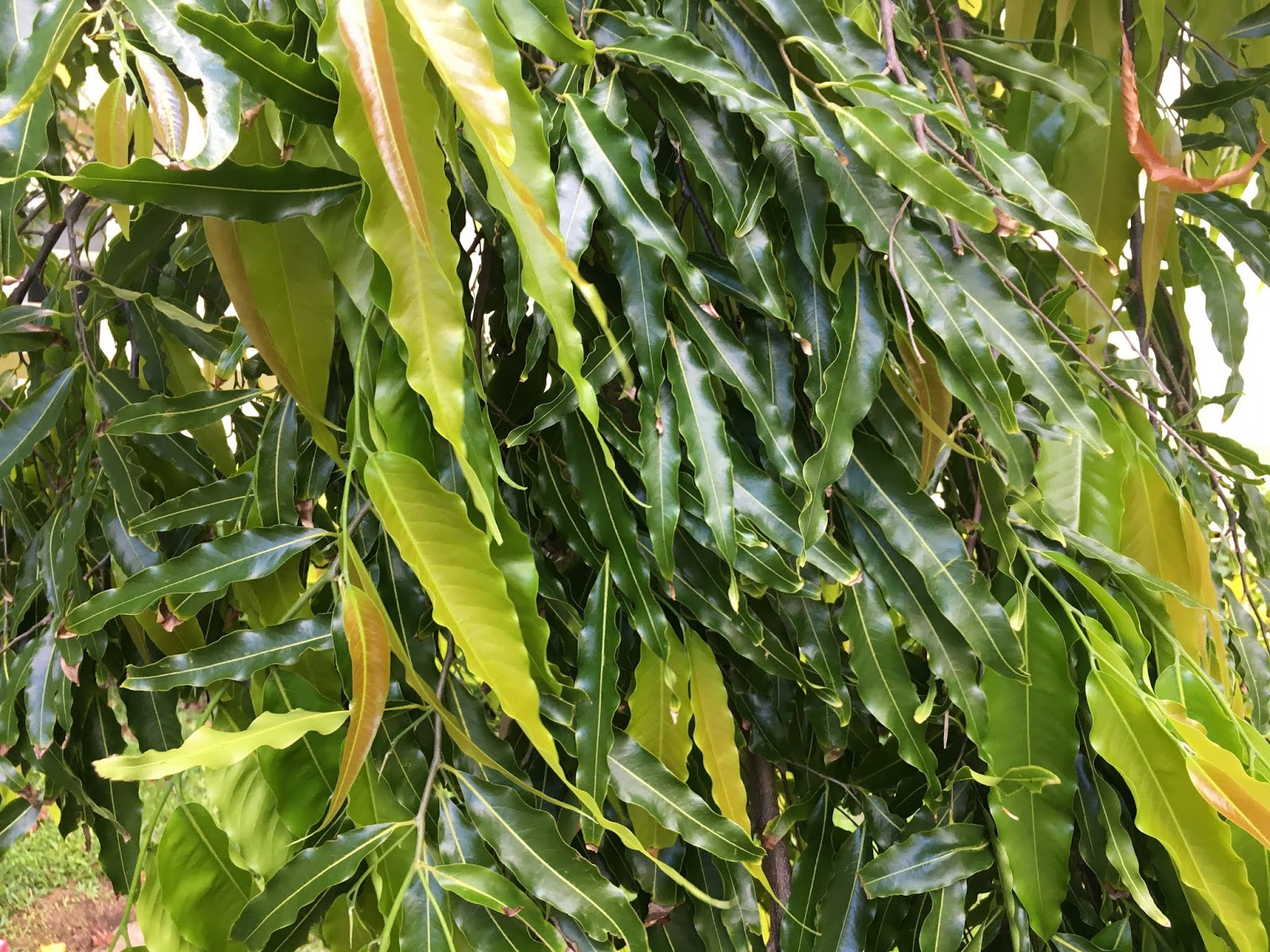
- Leaves: Alternate, lanceolate (12–30 cm × 3–7 cm), with
wavy margins and bronze young leaves (Fern, 2024).
- Flowers: Pale green, star-like, bisexual (3–4 cm
diameter), borne in axillary fascicles; bloom for 2–3 weeks (Jothy et al.,
2013).
- Fruit: Berry-like drupes (1–2 cm), green turning black;
dispersed by birds (Burkill, 1995).
- Native Range: India and Sri Lanka (Kew Science, 2023).
- Introduced: Widely cultivated in tropical Africa, Southeast
Asia, and Australia.
- Habitat: Dry forests and urban areas, 0–1,000 m altitude,
in loamy soils (pH 5.5–7.5) with rainfall 800–2,500 mm.
- Ecological Role: Provides habitat and nectar for pollinators and
reduces urban noise and dust (Firdous et al., 2022).
- Antimicrobial: Leaf extracts inhibit Staphylococcus aureus and Escherichia coli (MIC:
0.5–1 mg/mL) (Uzama et al., 2011).
- Antiviral: Methanolic extracts inhibit peste des petits
ruminants and Newcastle disease viruses (Yadav et al., 2020).
- Anti-inflammatory: Clerodane diterpenoids reduce edema and COX-2
activity (Yao et al., 2019).
- Anticancer: Leaf extracts induce apoptosis in HeLa cells
(IC50 ≈ 100 μg/mL) (Vijayarathna et al., 2017).
- Antidiabetic: Extracts lower blood glucose by 40% in diabetic
rats (Firdous et al., 2022).
- Nephroprotective: Ethanolic root extract mitigates
vancomycin-induced renal toxicity (Das et al., 2023).
- Antipyretic: Bark decoctions reduce yeast-induced fever
(Burkill, 1995).
- Ethnoveterinary: Leaf meal acts as a natural antibiotic in poultry
feed (Alagbe, 2017).
⚠ Toxicity Profile: Polyalthia longifolia shows
low acute toxicity. Oral LD50 in rats exceeds 3,200 mg/kg. Sub-acute studies
(300 mg/kg for 28 days) revealed no hematological abnormalities. High doses
(>1,000 mg/kg) may cause mild gastrointestinal upset. Use during pregnancy
is not recommended (Chanda et al., 2012; Firdous et al., 2022).
- Timber: Used for pencils, boxes, and matchsticks due to
its fine grain (Fern, 2024).
- Ornamental: Popular as an urban avenue tree for noise
reduction and aesthetics.
- Phytobiotic: Leaf meal enhances growth in broiler diets
(Alagbe, 2017).
- Cultural Use: Planted around temples in India for auspicious
significance (Firdous et al., 2022).
- Alagbe, J. O. (2017).
Effect of dietary inclusion of Polyalthia longifolia leaf meal as phytobiotic
compared with antibiotics on performance, carcass characteristics and
haematology of broiler chicken. Journal of Agricultural Science, 7, 68–74.
- Burkill, H. M.
(1995). The useful plants of West Tropical Africa (Vol. 3). Royal Botanic Gardens, Kew.
- Chanda, S., Dave, R.,
Kaneria, M., & Shukla, V. (2012). Acute oral toxicity of Polyalthia
longifolia var. pendula leaf extract in Wistar albino rats. Pharmaceutical Biology, 50(11), 1408–1415.
- Das, K., et al. (2023).
Nephroprotective potential of Polyalthia longifolia roots against
vancomycin-induced renal toxicity. Frontiers in Pharmacology, 14, 1107435.
- Fern, K. (2024).
Polyalthia longifolia. Useful Tropical Plants Database.
https://tropical.theferns.info/viewtropical.php?id=Polyalthia+longifolia
- Firdous, S. M., Ahmed,
S. N., Hossain, S. M., & Ganguli, S. (2022). Polyalthia longifolia:
Phytochemistry and pharmacological review. Medicinal Chemistry
Research, 31, 1252–1264.
https://doi.org/10.1007/s00044-022-02917-8
- Jothy, S. L., Choong, Y.
S., & Sasidharan, S. (2013). Polyalthia longifolia Sonn: An ancient
remedy. Research Journal of Pharmaceutical, Biological and Chemical
Sciences, 4(1), 714–729.
- Katkar, K. V., Suthar,
A. C., & Chauhan, V. S. (2010). The chemistry and pharmacologic
applications of Polyalthia longifolia. Pharmacognosy Reviews, 4(7), 62–68.
- Uzama, D., Machan, D.
B., & Asuquo, T. S. (2011). Comparative study on the antimicrobial
activities of ethanolic extracts of lemon grass and Polyalthia
longifolia. Journal of Applied Pharmaceutical Science, 1(6), 174–176.
- Vijayarathna, S., Oon,
C. E., Chen, Y., & Sasidharan, S. (2017). Polyalthia longifolia methanolic
leaf extracts induce apoptosis in HeLa cells. Biomedicine &
Pharmacotherapy, 89, 499–514.
- Yadav, P., Choudhury,
S., Barua, S., & Garg, S. K. (2020). Polyalthia longifolia leaves
methanolic extract targets viral entry and budding. Journal of
Ethnopharmacology, 248, 112279.
- Yao, L. J., Jalil, J.,
& Zakaria, N. A. (2019). The medicinal uses, toxicities and
anti-inflammatory activity of Polyalthia species (Annonaceae). Journal of
Ethnopharmacology, 229, 303–325.
 |