Millettia aboensis
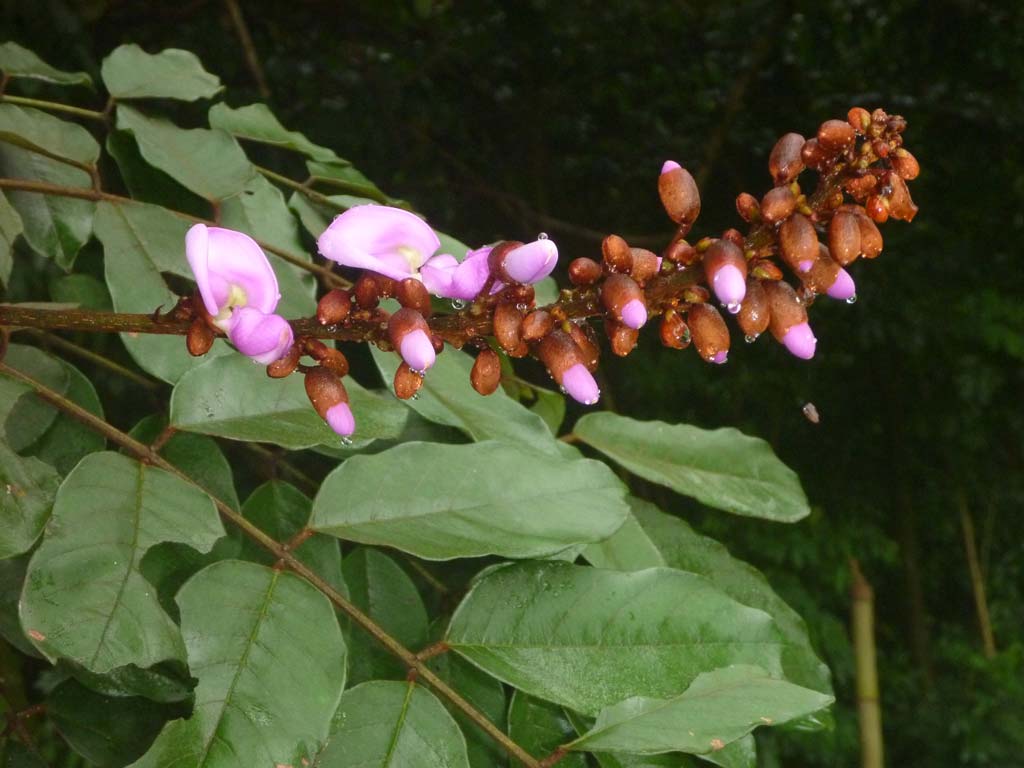
|
|
Millettia aboensis Common Names: Ndu ezi (Igbo), Odudu (Efik), Erurumesi
(Edo) Scientific
Classification Kingdom: Plantae Clade: Tracheophytes Clade: Angiosperms Clade: Eudicots Order: Fabales Family: Fabaceae Genus: Millettia Species: M. aboensis Binomial Name: Millettia aboensis (Hook.f.) Baker Synonyms: Millettia macrophylla
var. aboensis Hook., Phaseolodes aboensis (Baker) Kuntze, Phaseoloides aboense (Hook.) Kuntze Morphological Description Millettia aboensis is a medium-sized deciduous tree, typically reaching 10–20 m
in height with a trunk diameter of 30–50 cm. It is characterized by: · Bark: Greyish-brown, smooth when young, becoming fissured with age · Leaves: Pinnate, 15–25 cm long, with 5–9 ovate leaflets, dark green,
glossy · Flowers: Purple to lilac, 1–2 cm long, in terminal panicles, blooming
November–March · Pods: Rust-colored, velvety, 10–15 cm long, containing 2–4 brown,
disc-shaped seeds The seeds are
recalcitrant, requiring high moisture for viability (Forest Center, 2019). Distribution and Habitat Millettia aboensis is native to West Africa, predominantly southeastern Nigeria
(e.g., Cross River, Akwa Ibom) and extending to Gabon. It thrives in: · Habitats: Lowland tropical rainforests, swamp forests, riverine areas · Climate: Humid tropical, with rainfall of 2,000–3,000 mm annually,
temperatures of 25–30°C · Soil Conditions: Moist, well-drained loamy soils rich in
organic matter (pH 5.0–6.5) · Elevation: Sea level to 300 m Its conservation status
remains unassessed by the IUCN Red List, though habitat loss poses potential
threats (Ogundipe et al., 2018). Ethnopharmacology Millettia aboensis is a lesser-known but therapeutically significant plant in
traditional African medicine, particularly within regions of Nigeria. Various
parts of the plant—especially the leaves, roots, and bark—are used for their
notable medicinal properties, including antimicrobial, anti-inflammatory,
analgesic, antioxidant, and antimalarial effects. It is traditionally employed
in the treatment of fevers, malaria, rheumatism, wound infections, and
gastrointestinal disorders. Some local uses also involve its application in
managing skin conditions and pain-related ailments. Preliminary phytochemical
studies indicate the presence of flavonoids, alkaloids, saponins, and tannins,
which may be responsible for its biological activities. However, despite its
promising traditional applications, there is limited scientific literature
available, and more comprehensive pharmacological and toxicological studies are
needed to validate its efficacy and ensure safety for medicinal use. · Antioxidant
Activity: Studies have
demonstrated that the ethyl acetate fraction of M. aboensis leaf extract
possesses significant antioxidant properties, attributed to its high phenolic
content. Isolated compounds, such as epicathechin derivatives, showed potent
inhibition of liver microsome lipid peroxidation and synergistic DPPH radical
scavenging activity (Ajaghaku et al., 2020). · Anti-inflammatory
Activity: In vivo investigations
using carrageenan-induced paw edema models in rats indicated that the aqueous
methanol leaf extract of M. aboensis exhibits substantial anti-inflammatory
effects, with inhibition rates surpassing those of standard drugs like
piroxicam.(Ilo et al., 2021). · Estrogenic Effects: Research on ovariectomized
rats revealed that the root extract of M. aboensis has estrogenic activity,
suggesting its potential as a plant-derived alternative for hormone replacement
therapy (Ajaghaku et al., 2021). · Cytotoxic
and Antioxidant Properties:
Compounds isolated from the methanol root extract, including homopterocarpin and
maackain, exhibited notable cytotoxic effects against mouse lymphoma cell lines
and demonstrated antioxidant activities, indicating potential anticancer
applications (Ajaegbu et al., 2023). · Antidiabetic
and Antilipidemic Effects:
In alloxan-induced diabetic rat models, M. aboensis leaf extract significantly
reduced blood glucose and lipid levels, supporting its traditional use in
managing diabetes and associated dyslipidemia.( Ajaghaku et al., 2020) ⚠ Toxicity Profile: Acute toxicity studies have shown that M.
aboensis has a high safety margin, with no mortality observed at tested doses.
However, some studies have reported potential hepatotoxic effects at higher
concentrations, emphasizing the need for caution and further research to
establish safe dosage ranges. Phytochemistry The plant’s medicinal
properties are linked to its phytochemicals: · Procyanidins: Epicatechin-(2β→O→7, 4β→8)-cathechin, antioxidant and
wound-healing · Saponins: Laxative and antimicrobial effects · Flavonoids: Anti-inflammatory and antidiabetic activity · Phenolics: High content (305.2 mgGAE/g in ethyl acetate fraction),
antioxidant · Alkaloids: Potential hepatoprotective agents Additional Uses · Horticulture: Propagated for shade in agroforestry systems in Nigeria · Ecological: Nitrogen-fixing, enhances soil fertility in rainforests · Cultural: Seeds used in Igbo rituals for purification · Timber: Wood used for small tools in Gabon References
External Links More Pictures |
|
| Compounds of Millettia aboensis | |
| References |