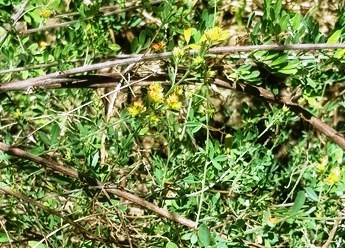
Indigofera pulchra.
|
|
Indigofera pulchra Common Names: Beautiful Indigo, Pretty Indigo, and Handsome
Indigo Scientific
Classification Kingdom: Plantae Phylum: Tracheophyta Class: Magnoliopsida Order: Fabales Family: Fabaceae Genus: Indigofera Species: Indigofera
pulchra Synonyms: Anil rufescens (Poir.) Kuntze, Indigofera dosycnium
Fenzl, Indigofera dupuisii Micheli, Indigofera pulchra var. andongensis Hiern,
Indigofera rufescens Poir., Indigofera polysphaera Baker, Indigofera
tenuisiliqua Schweinf. ex Baker f. (Plants of the World Online, n.d.; World
Flora Online, n.d.). Morphological Description Indigofera pulchra is an
erect, stiff, grey-pubescent, softly woody undershrub, typically growing 1–1.5
meters tall, occasionally reaching 2 meters in favorable conditions. Its morphology
is adapted to seasonally dry tropical biomes, with variability in leaf
structure enhancing its ecological adaptability. Key features include: · Stems: Grey-pubescent, softly woody, erect, with
a slender, branching habit; young stems green, turning greyish-brown with age. · Leaves: Dimorphic, pinnate; upper leaves
1–3-foliolate, lower leaves up to 11-foliolate; leaflets elliptic to obovate,
5–20 mm long, 3–10 mm wide, grey-green, pubescent; stipules lanceolate, 1–2 mm
long (Plants of the World Online, n.d.). · Flowers: Red to orange corolla, 4–6 mm long, in
terminal racemes (sometimes condensed, subcapitate); calyx brownish, 2–3 mm
long; standard petal ovate; flowering from July to November in West Africa
(Garba et al., 2008). · Fruit: Pods cylindrical, 3–5 mm long, 2–3 mm
wide, pubescent, brown at maturity, containing 1–2 seeds; seeds ovoid, 1–2 mm
long, brown (World Flora Online, n.d.). · Roots: Taproot system, fibrous, aiding drought
tolerance and soil stabilization in savanna ecosystems (Gerometta et al.,
2020). The plant’s pubescent
foliage and compact pods contribute to its resilience in arid environments,
while its colorful flowers attract pollinators like bees and butterflies. Distribution and Habitat Indigofera pulchra is
native to tropical Africa, with a distribution spanning Senegal, Gambia,
Guinea, Sierra Leone, Mali, Burkina Faso, Ghana, Nigeria, Cameroon, Chad,
Sudan, Ethiopia, Angola, and Tanzania. It thrives in: · Savannas: Common in open savanna woodlands with
annual rainfall of 400–1,200 mm and temperatures of 25–35°C (Plants of the
World Online, n.d.). · Open Woodlands: Found in seasonally dry,
well-drained soils, often sandy or loamy, with pH 5.0–7.5, at altitudes of
100–1,800 meters. · Disturbed Areas: Occurs along roadsides, fallow
fields, and rocky outcrops, tolerating moderate disturbance and grazing
pressure (Gerometta et al., 2020). Its wide distribution
and adaptability to dry conditions make it a key species in savanna ecosystems,
though it is not considered invasive (World Flora Online, n.d.). Ethnopharmacology Indigofera pulchra is
widely used in traditional African medicine, particularly in Nigeria, Senegal,
and Sierra Leone, for various ailments. Ethnopharmacological studies validate
several traditional uses, highlighting its potential as a source of bioactive
compounds, notably flavonoids, dihydrostilbenes, and saponins. Key medicinal
uses include: · Antidiarrheal: In northern Nigeria, decoctions
of aerial parts are used to treat diarrhea, supported by studies showing
dose-dependent protection against castor oil-induced diarrhea in mice (100%
protection at 200 mg/kg) and relaxation of rabbit jejunum, likely via
histaminergic and cholinergic mechanisms (Garba et al., 2008). · Wound Healing: Leaf extracts are applied
topically in Sierra Leone and Nigeria to treat infected wounds. · Anti-inflammatory: Aerial part decoctions are
used in Nigeria for inflammation, · Analgesic: In Nigeria, leaf infusions are used
for pain relief, · Snakebite Antidote: In Senegal and Nigeria,
aerial part decoctions are used as a prophylactic against snakebites, with
studies confirming venom-neutralizing activity against *Naja nigricollis*
venom, possibly due to saponins and steroids (Abubakar et al., 2006). · Gastrointestinal Disorders: In northern Nigeria,
the plant is used to treat stomach aches and dysentery, supported by
phytochemicals like tannins and glycosides that exhibit antispasmodic effects
(Garba et al., 2008). Phytochemical analyses
reveal flavonoids (e.g., quercetin, gallic acid), dihydrostilbenes (e.g.,
3-methoxy-4,5-methylenedioxy-dihydrostilbene), tannins, saponins, steroids, and
glycosides, contributing to its pharmacological activities. However, limited
clinical studies and potential toxicity necessitate cautious use (Musa et al.,
2011; Garba et al., 2021). ⚠ Toxicity Profile: Limited data exist on the toxicity of Indigofera
pulchra, but preliminary studies suggest moderate safety with precautions. Key
toxicity details include: Acute Toxicity: The intraperitoneal LD50 of
methanolic aerial part extract in mice is 2,154 mg/kg, indicating moderate
toxicity; no acute toxicity was observed at oral doses up to 5,000 mg/kg (Garba
et al., 2008). Cytotoxicity: Dihydrostilbenes from aerial parts show weak
activity against methicillin-resistant *Staphylococcus aureus* (MRSA) but no
significant cytotoxicity in mammalian cell lines, suggesting low risk at
therapeutic doses (Garba et al., 2021). Human Risk: No human poisoning cases
are reported, but prolonged use or high doses may cause gastrointestinal upset
or liver stress due to flavonoid and saponin accumulation, particularly in
children or pregnant women (Burkill, 1995). Additional Uses · Forage: Aerial parts are used as fodder for
livestock in Nigeria and Senegal, particularly during dry seasons, due to its
moderate nutritional content. · Soil Stabilization: The fibrous root system is
planted in Nigeria to prevent erosion on degraded lands, enhancing savanna
restoration (Gerometta et al., 2020). · Ornamental: Occasionally cultivated in West
African gardens for its attractive red-orange flowers, though less common than
other Indigofera species (World Flora Online, n.d.). References
External Links More Pictures |
|
| Compounds of Indigofera pulchra. | |
| References |