Ochna schweinfurthiana
|
|
Ochna schweinfurthiana Common Names: Brick-red Ochna, African mickey mouse plant Scientific
Classification Kingdom: Plantae Phylum: Streptophyta Class: Equisetopsida Subclass: Magnoliidae Order: Malpighiales Family: Ochnaceae Genus: Ochna Species: Ochna
schweinfurthiana Synonyms: Diporidium schweinfurthianum (F.Hoffm.) Tiegh., Ochnella
schweinfurthiana (F.Hoffm.) Tiegh., Ochna alba (Tiegh.) A.Chev., Ochna
axillaris A.Chev., Ochna suberosa De Wild., Ochnella alba Tiegh., Ochnella
aurea Tiegh., Ochnella axillaris Tiegh., Ochna polyarthra Baker (Plants of the
World Online, n.d.). Morphological Description Ochna schweinfurthiana
is a shrub or small evergreen tree, typically growing 2–7 meters tall,
occasionally reaching 10 meters in favorable conditions. Its morphology is
adapted to tropical and subtropical environments, with ornamental and
ecological significance. Key features include: · Bark: Dark grey, corrugated, or reticulately
fissured, corky; young branches with white to pale yellowish-brown bark peeling
in papery strips, mostly lacking lenticels (Flora of Zimbabwe, n.d.). · Leaves: Coriaceous, obovate-oblanceolate to oblong,
5.5–13.5 cm long, 1.7–6.5 cm wide; margins densely curved-serrulate; petioles
2–5 mm long; leaves glossy green, turning yellow in autumn (Bandi et al.,
2012). · Flowers: Bright yellow, 1.5–2 cm in diameter,
short-lived (lasting 1–2 days), borne in racemes or panicles before or with
young leaves; petals 5, caducous; stamens numerous; flowering from September to
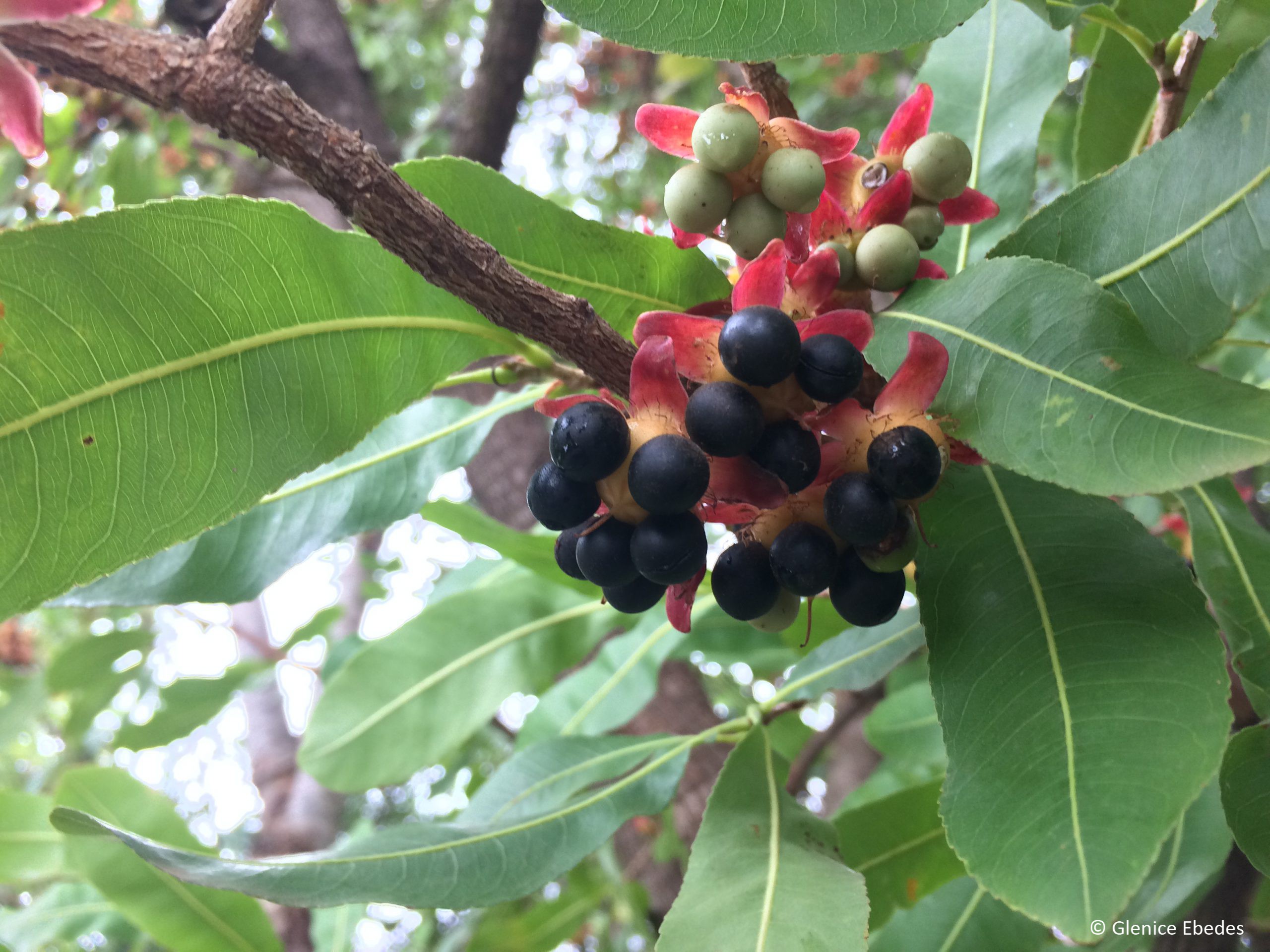
February in southern Africa (Flora of Zimbabwe, n.d.). · Fruit: Black, subglobose drupelets, 7–9 mm long, 1–5
per flower; sepals enlarge and turn cherry to brick red at maturity, persisting
around fruits, resembling a Mickey Mouse face; fruiting from December to April
(Plants of the World Online, n.d.). · Roots: Woody, fibrous, with a shallow root system,
aiding soil stabilization in rocky terrains (Hyde et al., 2024). The plant’s vibrant
flowers and colorful fruiting structures make it a popular ornamental species,
while its coriaceous leaves and fissured bark enhance its resilience in harsh
environments (Bandi et al., 2012). Distribution and Habitat Ochna schweinfurthiana
is widely distributed across tropical Africa, from Guinea and Mali in West
Africa to Sudan in East Africa, and south to Zimbabwe and Mozambique. It is
prevalent in Nigeria, Cameroon, Ethiopia, and Tanzania. Preferred habitats
include: · Deciduous
Woodlands: Thrives in open
woodlands with annual rainfall of 500–1,500 mm and temperatures of 20–30°C
(Hyde et al., 2024). · Wooded
Grasslands: Common in savanna
ecosystems, particularly on rocky hillsides, scarps, and termite mounds, at altitudes
of 750–2,100 meters (Flora of Zimbabwe, n.d.). · Disturbed
Areas: Occurs along forest
edges and in secondary growth areas, tolerating well-drained, sandy, or loamy
soils with pH 5.5–7.0 (Plants of the World Online, n.d.). Its adaptability to
diverse ecological conditions contributes to its widespread distribution,
though it may become invasive in some regions due to seed dispersal by birds
(Bandi et al., 2012). Ethnopharmacology Ochna schweinfurthiana
is extensively used in traditional African medicine, particularly in Nigeria,
Cameroon, and Benin, for a range of ailments. Ethnopharmacological studies
validate several traditional uses, highlighting its potential as a source of
bioactive compounds, particularly flavonoids. Key medicinal uses include: · Malaria
Treatment: In northern Cameroon,
pounded stem bark decoctions are used to treat malaria fever, supported by
studies showing antiplasmodial activity of flavonoid-rich extracts (Kweyamba et
al., 2019). · Wound
Healing: Leaf, root, and stem
bark extracts are applied as poultices or decoctions in Nigeria and Benin to
promote wound healing, attributed to flavonoids and phenolic compounds with
antimicrobial and tissue-regenerative properties (Adetutu et al., 2011). · Anti-inflammatory: In northern Nigeria, leaf infusions are used to
alleviate pain and inflammation, validated by in vitro inhibition of
15-lipooxygenase and bovine serum albumin denaturation, linked to biflavonoids
like amentoflavone and agathisflavone (Djova et al., 2019). · Antimicrobial: Stem and leaf extracts are used in Nigeria to
treat bacterial and fungal infections, with studies confirming activity against
Staphylococcus aureus, Escherichia coli, and Candida albicans, due to flavonoids and
terpenes (Danmusa et al., 2015). · Pain
Management: In Cameroon, root
decoctions are used for analgesic purposes, supported by antinociceptive
properties of methanolic leaf extracts in animal models (Ya’u et al., 2020). · Fractures
and Sprains: In Benin, stem bark is
combined with other plants to treat fractures and sprains, with traditional
healers citing its anti-inflammatory and tissue-repair properties (Favi et al.,
2023). Phytochemical analyses
reveal a rich profile of flavonoids (e.g., amentoflavone, agathisflavone),
glycosides, steroids, and terpenes, contributing to its pharmacological
activities. However, limited clinical studies and potential cytotoxicity
require cautious use (Djova et al., 2019; Ndongo et al., 2015). ⚠ Toxicity Profile: Limited data exist on the toxicity of Ochna schweinfurthiana, but
preliminary studies suggest potential risks, particularly with prolonged or
high-dose use. Key toxicity details include: Cytotoxicity: Ethyl acetate
extracts from stem bark show cytotoxicity against cervical adenocarcinoma
(HeLa) cells, with IC50 values of 10.0–20.7 μM for compounds like
agathisflavone and amentoflavone, indicating potential toxicity to normal cells
at high concentrations (Ndongo et al., 2015). Genotoxicity: Aqueous bark
extracts exhibit no genotoxicity in Salmonella typhimurium strains TA98 and
TA100, suggesting low mutagenic risk, but further studies are needed (Djova et
al., 2019). Human Risk: No direct human poisoning cases are reported, but
traditional use in high doses or without proper preparation may cause adverse
effects, particularly in pregnant women or individuals with liver conditions,
due to flavonoid accumulation (Bandi et al., 2012). Precautions: Medicinal use
should be supervised by trained practitioners. Avoid prolonged use or
application on open wounds without dilution. Further toxicological studies are
essential to establish a safety profile (Danmusa et al., 2015). Additional Uses · Ornamental: Cultivated for its bright yellow flowers and
brick-red fruiting structures, used in gardens and as a bonsai species in
Nigeria and South Africa (Bandi et al., 2012). · Dye
Production: Stem bark and roots
yield yellow to red dyes used in traditional textiles in Cameroon and Nigeria
(Flora of Zimbabwe, n.d.). · Agri-horticulture: Planted as a hedge or boundary marker in rural
Nigeria, aiding soil stabilization on rocky slopes (Hyde et al., 2024). · Firewood: Woody stems are used as fuel in rural
communities, though less preferred due to its slow growth (Favi et al., 2023). References Bandi, A. K., Lee, D.
U., Tih, R. G., Gunasekar, D., & Bodo, B. (2012). Phytochemical and
biological studies of Ochna species. Chemistry &
Biodiversity, 9(2), 251–271. Danmusa, U. M., Nasir,
I. A., Abdullahi, M. I., Ahmad, A. A., & Abdulkadir, I. S. (2015).
Phytochemical analysis and antimicrobial activities of methanolic stem extracts
of Ochna schweinfurthiana F.Hoffm. Journal of Pharmacy & Pharmacognosy Research, 3(6), 171–182. Djova, S. V., Nyegue, M.
A., Messi, A. N., Afagnigni, A. D., & Etoa, F. X. (2019). Phytochemical
study of aqueous extract of Ochna schweinfurthiana F. Hoffm powder bark and
evaluation of their anti-inflammatory, cytotoxic, and genotoxic
properties. Evidence-Based Complementary and Alternative Medicine, 2019, 8908343. Favi, G. A., Bogninou,
G. S. R., Dassou, G. H., Yehouenou, B. T., Houndjo, T. D. D., & Yedomonhan,
H. (2023). Ethnobotanical study of medicinal plants used in the treatment of
fractures, wounds, and sprains in Atakora and Donga, northern Republic of
Benin. Journal of Ethnobiology and Ethnomedicine, 19, 48. Flora of Zimbabwe.
(n.d.). Ochna schweinfurthiana. Retrieved from
https://www.zimbabweflora.co.zw/speciesdata/species.php?species_id=140320 Hyde, M. A., Wursten, B.
T., Ballings, P., & Coates Palgrave, M. (2024). Ochna schweinfurthiana
F.Hoffm. In Flora of Zimbabwe. Retrieved from
https://www.zimbabweflora.co.zw/speciesdata/species.php?species_id=140320 Kweyamba, P. A., Zofou,
D., Efange, N., Assob, J. N., Kitau, J., & Nyindo, M. (2019). In vitro and
in vivo studies on anti-malarial activity of Commiphora africana and
Dichrostachys cinerea used by the Maasai in Arusha region, Tanzania. Malaria Journal, 18, 1–10. Ndongo, J. T., Issa, M.
E., Messi, A. N., Mbing, J. N., Cuendet, M., Pegnyemb, D. E., & Bochet, C.
G. (2015). Cytotoxic flavonoids and other constituents from the stem bark of
Ochna schweinfurthiana. Natural Product Research, 29(17), 1684–1687. Plants of the World
Online. (n.d.). Ochna schweinfurthiana F.Hoffm. Retrieved from
https://powo.science.kew.org/taxon/urn:lsid:ipni.org:names:606774-1 Ya’u, A. J., Ibrahim,
Y., Musa, A., & Abdullahi, M. A. (2020). Ethnobotany, phytochemistry and
pharmacology of Ochna schweinfurthiana: A review. Universal Journal of
Pharmaceutical Research,
4(6), 1–10. External Links Ochna schweinfurthiana - Wikipedia Ochna
schweinfurthiana - Plants of the World Online Ochna
schweinfurthiana - World Flora Online Ochna schweinfurthiana - PlantBook Ochna
schweinfurthiana - PlantNet Ochna
schweinfurthiana - African Plants More Pictures |
|
| Compounds of Ochna schweinfurthiana | |
| References | Murtala Muhammad, Etal. (2023). Phytochemical analysis of Nigerian medicinal plants. NMPP-DB
Project, Department of Biochemistry, Kano University of Science and Technology,
Wudil |