|
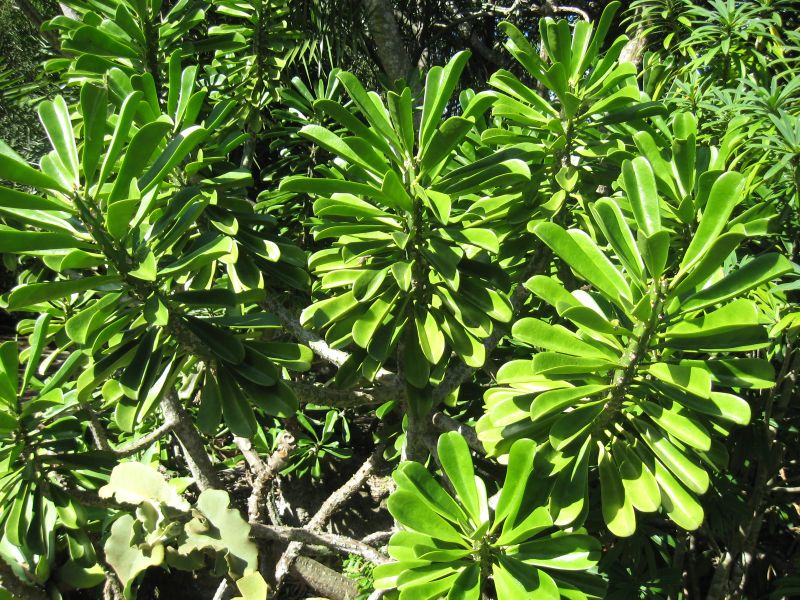
Euphorbia drupifera Thonn.
Common Names: Olive spurge, Plum-fruited spurge
Local Names:
Species ID: NMP-261 | wfo-0001049173 | NCBI_Taxonomy ID:
212879
Scientific
Classification
Kingdom: Plantae
Clade: Angiosperms
Clade: Eudicots
Clade: Rosids
Order: Malpighiales
Family: Euphorbiaceae
Genus: Euphorbia
Species: E. drupifera
Synonyms: Elaeophorbia
drupifera (Thonn.) Stapf; Euphorbia elastica Poiss. & Pax; Euphorbia
renouardii Pax; Euphorbia toxicaria Afzel. ex Steud.
Morphological Description
- Habit: Succulent
shrub or small tree, typically 2–6 m tall (up to ~10 m), with rounded or
spreading crown (Burkill, 1985; POWO).
- Bark/latex: Grey-brown
bark with longitudinal fissures; copious white latex that is irritant
(Burkill, 1985; Useful Tropical Plants).
- Leaves: Simple,
alternate, elliptic to oblong (5–15 × 2–6 cm), dark-green glossy, short
petioles (Fern, 2024).
- Flowers: Greenish-yellow
unisexual flowers in cyathia (specialized Euphorbia inflorescences),
blooming seasonally (Prance & Jongkind, 2015).
- Fruit: Globose
to slightly lobed capsules (≈8–12 mm), green to reddish-brown at maturity;
seeds dispersed by explosive dehiscence (POWO; Fern, 2024).
- Geographic range: West
and Central Africa (e.g., Nigeria, Ghana, Benin, Togo, Côte d’Ivoire,
Cameroon, DR Congo) and into East Africa (Uganda, Tanzania) (Plants of the
World Online; Useful Tropical Plants).
- Habitats: Dry
savannas, woodlands, forest edges, disturbed sites; prefers well-drained
sandy/rocky soils with ~800–1,500 mm rainfall; to ~1,200 m elevation
(Fern, 2024).
- Ecology: Pioneer
in disturbed areas; latex deters herbivory; flowers visited by bees/flies
(Burkill, 1985).
- Antibacterial (including MDR strains): Methanol leaf extract and fractions showed broad
antibacterial activity with MICs ranging 32–1,024 μg/mL; subfraction EDLc3
achieved MIC 16 μg/mL against MRSA11 and EDLc33 recorded 8 μg/mL against
Providencia stuartii NAE16. Isolated constituents included stigmasterol,
β-sitosterol, euphol, and methylellagic acid glycosides (Voukeng et al.,
2017).
- Antiviral (HIV-1/HIV-2): Comparative in vitro study reported activity of
E. drupifera extract against HIV-1 and HIV-2 relative to AZT, supporting
traditional claims (Ayisi & Nyadedzor, 2003).
- Cytotoxic/anticancer: Extracts
displayed cytotoxicity toward drug-sensitive and multidrug-resistant human
cancer cell lines; E. drupifera extracts achieved low IC50 values (sub-10
μg/mL reported against some lines), suggesting apoptosis-related
mechanisms (Kuete et al., 2013).
- Cardiovascular effects: Root extract produced significant cardiovascular
actions in experimental models (e.g., hypotensive/vasoactive profiles),
aligning with some folk uses (Eno & Owo, 1999).
- Uterine smooth muscle/cholinoceptor action: Leaf extract stimulated autonomic cholinoceptors
in rat uterus, indicating notable smooth-muscle pharmacology (Eno &
Itam, 1998).
- Hypoglycaemic potential: “Hypoglycaemic agent(s)” reported from the leaves
in a pharmacological note (Eno & Itam, 1999).
⚠ Toxicity & Safety:
Euphorbia latex is a
potent irritant: dermal exposure can cause contact dermatitis and ocular
exposure can lead to severe keratoconjunctivitis and temporary blindness;
ingestion irritates the GI tract. These hazards are well documented across
Euphorbia spp., and the latex of E. drupifera should be handled with eye/skin
protection (Useful Tropical Plants; StatPearls review on Euphorbia latex;
recent ocular case literature). Avoid use in pregnancy/children. Seek medical
care for eye exposure (StatPearls; case literature).
Euphol (triterpenoid)
β-Sitosterol
Stigmasterol
Sitosterol-O-β-D-xylopyranoside
3,3′,4′-Tri-O-methylellagic
acid
Ellagic acid glycosides
Afzelin
(kaempferol-3-O-rhamnoside)
Quercetin-3-O-β-xylopyranoside
Ingenol reported in
related Elaeophorbia spp.
Identifications above
are from isolation work on E. drupifera leaves and active fractions (Ahiahonu
& Goodenowe, 2007; Voukeng et al., 2017) and earlier reports of ingenane
diterpenes in Elaeophorbia spp. (Kinghorn & Evans, 1974).
- Ornamental/xeriscape: Drought-tolerant,
used in hedges and dry-zone landscaping (Fern, 2024).
- Cultural: Latex
used in certain West African traditional practices (Burkill, 1985).
- Ecological: Pioneer
on degraded soils; latex deters grazing; supports pollinator visitation
(Burkill, 1985; Fern, 2024).
- Ahiahonu, P. W. K.,
& Goodenowe, D. B. (2007). Triterpenoids from leaves of Elaeophorbia drupifera. Fitoterapia, 78(5), 337–341.
- Ayisi NK, Nyadedzor C.
Comparative in vitro effects of AZT and extracts of Ocimum gratissimum, Ficus
polita, Clausena anisata, Alchornea cordifolia, and Elaeophorbia drupifera
against HIV-1 and HIV-2 infections. Antiviral Res. 2003 Mar;58(1):25-33. doi:
10.1016/s0166-3542(02)00166-3. PMID: 12719004.
- Burkill, H. M.
(1985). The useful plants of West Tropical Africa (Vol. 1). Royal Botanic Gardens, Kew.
- Eno, A. E., & Itam,
E. H. (1998). Stimulation of autonomic cholinoceptors in the rat uterus by a
crude extract from Elaeophorbia drupifera leaves. Pharmaceutical Biology, 36(2), 97–102.
- Eno, A. E., & Itam,
E. H. (1999). Hypoglycaemic agent(s) in leaves of Elaeophorbia drupifera. Phytotherapy Research, 13(8), 680–682. https://doi.org/10.1002/(SICI)1099-1573(199612)10:8%3C680::AID-PTR881%3E3.0.CO;2-C
- Eno, A. E., & Owo,
O. I. (1999). Cardiovascular effects of an extract from the roots of a
shrub Elaeophorbia drupifera. Phytotherapy Research, 13(7), 549–554. https://doi.org/10.1002/(sici)1099-1573(199911)13:7%3C549::aid-ptr464%3E3.0.co;2-q
- Fern, K. (2024). Euphorbia drupifera. Useful Tropical Plants.
https://tropical.theferns.info/viewtropical.php?id=Euphorbia+drupifera
- Kinghorn, A. D., &
Evans, F. J. (1974). The occurrence of ingenol in Elaeophorbia species. Planta Medica, 26(2), 150–154.
- Kuete, V., Voukeng, I.
K., Tsobou, R., Mbaveng, A. T., Wiench, B., Beng, V. P., & Efferth, T.
(2013). Cytotoxicity of Elaoephorbia drupifera and other Cameroonian medicinal plants
against drug-sensitive and multidrug-resistant cancer cells. BMC Complementary and
Alternative Medicine, 13, 250.
- Plants of the World
Online. (n.d.). Euphorbia drupifera Thonn. Royal Botanic Gardens, Kew.
https://powo.science.kew.org/taxon/urn:lsid:ipni.org:names:346326-1
- Prance, G. T., &
Jongkind, C. C. H. (2015). Euphorbiaceae. In Flora of West Tropical
Africa. Royal Botanic Gardens,
Kew.
- StatPearls.
(2023). Euphorbia tirucalli toxicity. StatPearls Publishing. https://www.ncbi.nlm.nih.gov/books/NBK574526/
(general Euphorbia latex toxicity reference)
- Useful Tropical Plants.
(n.d.). Euphorbia drupifera – notes on uses and hazards.
https://tropical.theferns.info/viewtropical.php?id=Euphorbia+drupifera
- Voukeng, I. K.,
Kammalac, T. N., Gohlke, S., Kouipou, R. M. T., Aslan, A., Kuzu, M., … Boyom,
F. F. (2017). Antibacterial activities of the methanol extract, fractions and
compounds from Elaeophorbia drupifera leaves against MDR bacteria. BMC Complementary
Medicine and Therapies, 17, 517.
 |